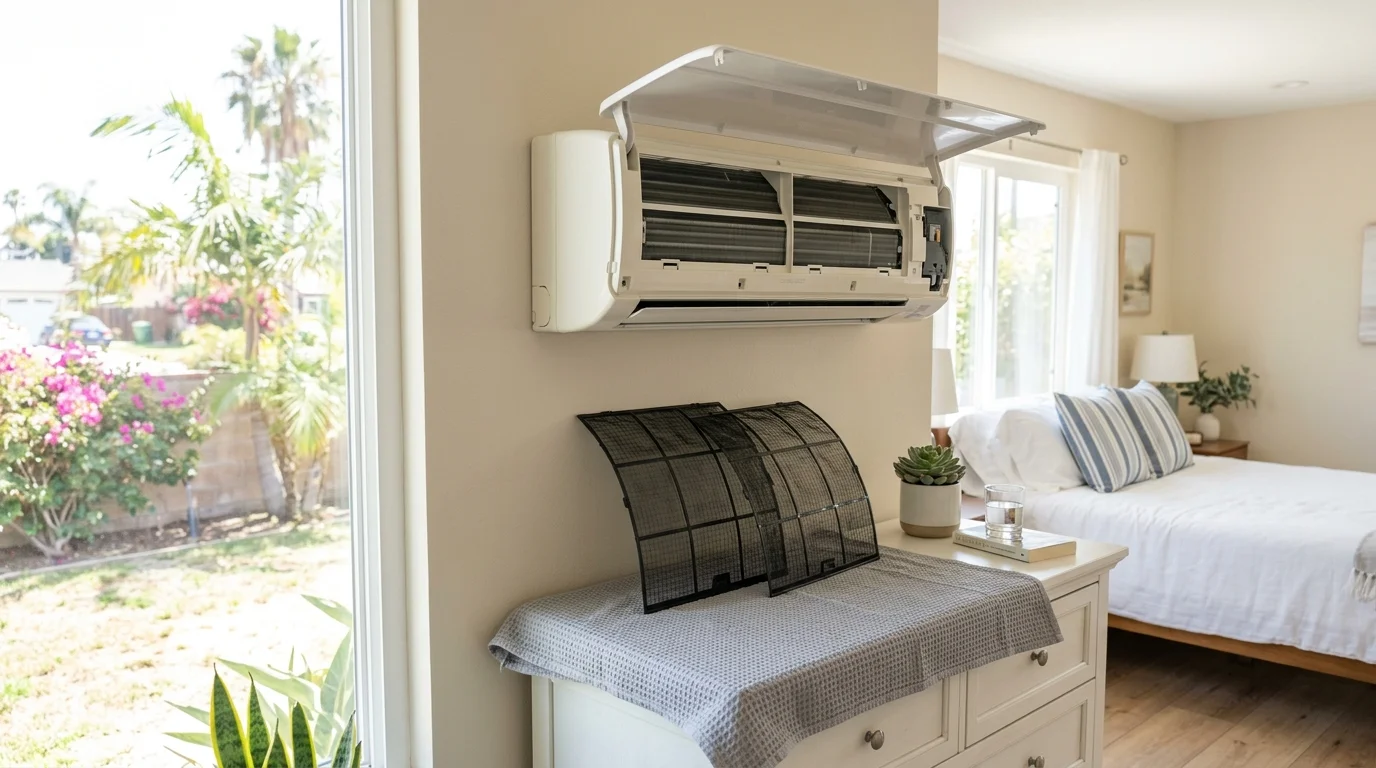
Ductless mini-split maintenance in San Diego starts at the wall-mounted head, not a hallway return. Its filters, blower wheel, drain pan, and condensate path sit inside or behind that room unit. Dust, odor, or a new drip can point to something a quick exterior wipe won’t reach. El Cajon is used below as a worked example of inland rooms, additions, and ADUs. The same owner-versus-contractor boundary applies countywide.
Why a mini split needs a different routine than a ducted system
A ducted system moves room air through shared return grilles and hidden ductwork. A ductless unit handles that exchange at the indoor head. That puts several maintenance points directly inside the room where you sleep, cook, work, or store things.
Location changes what each head collects. A unit near a kitchen may encounter cooking residue. A bedroom head may collect lint from fabrics and bedding. A converted garage or backyard ADU may see dust from open doors, tools, and nearby grading. Those differences show up inland as well as on the coast. In El Cajon, older houses near downtown and additions around Fletcher Hills and Granite Hills collect different dust than a coastal bedroom. Inspect the head you have. Don’t copy a central-system checklist.
Each indoor head can also develop a different maintenance need. A lightly used guest room won’t always match a busy living area. The room’s use, visible condition, and manufacturer instructions should guide the routine. Don’t copy a central-system checklist and assume every service point is covered.
Start by finding the model label and the care section in its manual. That tells you which covers and filters are meant for homeowner access. It also identifies the cleaning methods intended for that model. If you’re still choosing equipment or head locations, a licensed contractor can review those details during a ductless mini-split installation consultation.
The simple distinction is this: filter washing is routine owner care when the manual allows it. Blower, coil, pan, drain, and electrical access may require a licensed HVAC contractor. Knowing that boundary prevents a small cleaning task from becoming an improvised repair.
The blower wheel, and why it causes the smell
The blower wheel sits behind the outlet louvers and moves air into the room. Its narrow vanes can collect dust and residue that passed through or around the filters. When that material remains on damp interior surfaces, the moving air may carry an unpleasant odor into the room.
A smell doesn’t identify the source by itself. Residue on the blower wheel is one possibility. The coil, drain pan, condensate path, or a nearby room source may also deserve inspection. Notice when the odor appears, which operating mode is active, and whether it comes from one head or several.
Begin with the parts your manual identifies for routine cleaning. Check the mesh filters and the visible intake area. Look through the outlet without pushing tools past the louvers. A surface wipe can clean the case, but it doesn’t reach material deeper on the wheel.
Use only the products and methods named by the manufacturer. Household sprays can leave fragrance or residue inside the air path. If the manual doesn’t describe blower-wheel cleaning as owner maintenance, leave the internal assembly closed.
Call a licensed contractor when odor remains after allowed filter care. The contractor can inspect the wheel, coil, drain pan, and condensate route without guessing from smell alone. Ask the contractor to identify the source before approving cleaning or repair work. Staining, dust, and moisture can look similar from the floor, so visual appearance alone isn’t a diagnosis.
Washing the mesh filters on the indoor head
Many wall-mounted heads place mesh filters behind a hinged front cover. These aren’t the same as a disposable filter in a central return grille. Your model’s manual will say whether they can be washed, how they come out, and which cleaning method applies.
Before opening the cover, stop operation and follow the shutdown steps in the manual. Note how each filter sits in its track. Some heads also contain smaller inserts that serve a different purpose. Don’t rinse, vacuum, or discard an insert unless its instructions allow that treatment.
A careful routine usually focuses on a few basic points:
- Support the cover without forcing its hinges.
- Remove only the pieces identified for user care.
- Clean each filter with the method stated in the manual.
- Let the filter reach the condition required before reinstalling it.
- Seat every edge correctly before closing the cover.
Don’t set a cleaning calendar based only on another home. San Diego households use their systems differently. An El Cajon house with inland dust and long cooling runtimes is not the same as a coastal condo that barely runs. Open windows, pets, remodeling dust, cooking, and long operation change what reaches the filter. Inspect it according to the manufacturer’s schedule and sooner when the intake looks loaded.
Filter care also has limits. A clean mesh screen doesn’t prove that the blower wheel, coil, pan, or drain is clean. If airflow still seems uneven, an odor remains, or residue is visible deeper inside, arrange an inspection instead of reaching into the head.
The condensate line and the drip you should never ignore
Cooling operation can produce moisture inside the indoor head. That moisture collects at the pan and leaves through the system’s condensate path. A new drip from the case, louvers, or wall opening deserves attention because water isn’t supposed to enter the occupied room.
Don’t diagnose the entire drain from the visible drip. A licensed contractor may need to inspect the pan, drain connection, tubing, pump, installation angle, and nearby wall opening. The correct checks depend on how that specific system was installed.
Start by documenting what happened. Photograph the wet area and note which head was operating. Record whether the water appeared during cooling, after shutdown, or while another indoor head was running. Those details help the contractor inspect the right path without treating every leak as the same problem.
Don’t pour an unlisted cleaner into the unit or push wire through an unknown drain route. Follow the maintenance steps in the manufacturer manual. If water is approaching electrical parts, leave the system off and arrange service.
Ask the contractor to show you where the condensate travels and where it ends. Some installations include a pump or a concealed section that isn’t visible from the room. Knowing the actual route makes later maintenance easier. It also helps separate indoor-head drainage from unrelated plumbing or exterior moisture.
A recurring drip needs more than towel cleanup. The contractor should identify the source, explain the proposed correction, and put the work in writing before proceeding.
How often a deep clean is actually needed here
There isn’t one calendar that fits every San Diego mini split. The manufacturer sets the routine inspection and cleaning guidance for each model. An El Cajon head that runs hard through inland heat may need a look sooner than a lightly used coastal guest room. Conditions inside the room determine whether deeper service may be needed before the next scheduled check.
Use visible and operational changes as inspection triggers, not diagnoses. Examples include persistent odor, residue beyond the filters, moisture at the head, or airflow that feels different from its normal pattern. Dust after nearby construction or a long stretch of open-window weather can also justify an earlier look.
Deep cleaning shouldn’t become a vague add-on. Ask what condition the contractor found and which parts need attention. A useful written scope identifies the indoor head, affected components, access method, cleaning process, and any separate repair recommendation. It should also distinguish routine filter care from internal disassembly.
Multi-zone homes need head-by-head notes. A shared outdoor system doesn’t make every room collect the same material. The kitchen, primary bedroom, garage conversion, and ADU may each have different conditions. Our guide to multi-zone mini splits in San Diego explains why room-by-room planning matters.
Keep the service record with the model information. Note what was inspected, what was cleaned, and what the contractor recommended watching. That history gives the next technician something better than a guess. It also helps you avoid approving the same loosely described service twice.
What a professional mini split cleaning involves
The scope should match the condition of the system. Before scheduling, ask the contractor to describe what the quoted service includes. “Mini split cleaning” can be unclear unless the indoor heads and components are named.
A written scope may address the filters, coil surface, blower wheel, drain pan, condensate route, louvers, and cabinet. It should also state whether covers or the blower assembly require removal. Ask how the contractor will protect the wall, flooring, furniture, and nearby belongings during wet cleaning.
Several details can change the work involved. These include the number of indoor heads, ceiling height, access around furniture, residue inside the wheel, and a concealed drain or condensate pump. A head mounted over a bed presents a different access problem than one above an open garage wall. Ask for those items to appear separately in the quote.
Cleaning and repair aren’t interchangeable. A cracked part, loose connection, drain fault, or control problem may need a separate diagnosis and written repair scope. Don’t approve replacement parts based only on a general cleaning description. Ask the contractor to show what was found and explain why the proposed work addresses it.
For broader system care, compare the cleaning scope with a maintenance tune-up. Confirm whether the outdoor unit, controls, operating condition, and each indoor head are included. That prevents assumptions about what the appointment covers.
Heat Pro SD connects homeowners with licensed independent HVAC contractors. Before authorizing work, check the contractor through the official California Contractors State License Board lookup. Match the business name and license details to the written proposal.
When to call us
Call when odor remains after allowed filter care, water appears at the head, airflow changes, or internal parts need access beyond the owner’s manual. Heat Pro SD is a referral service and performs no physical work. The Heat Pro SD line is voicemail with a recording-consent notice. Leave a message at (858) 400-4374.