The hallway thermostat already shows the number you set. Air is still coming out of the living-room register, and the pad unit on the side yard has not gone quiet. In San Diego County that mismatch is a real complaint, and it does not mean the same thing in Ocean Beach as it does in Alpine.
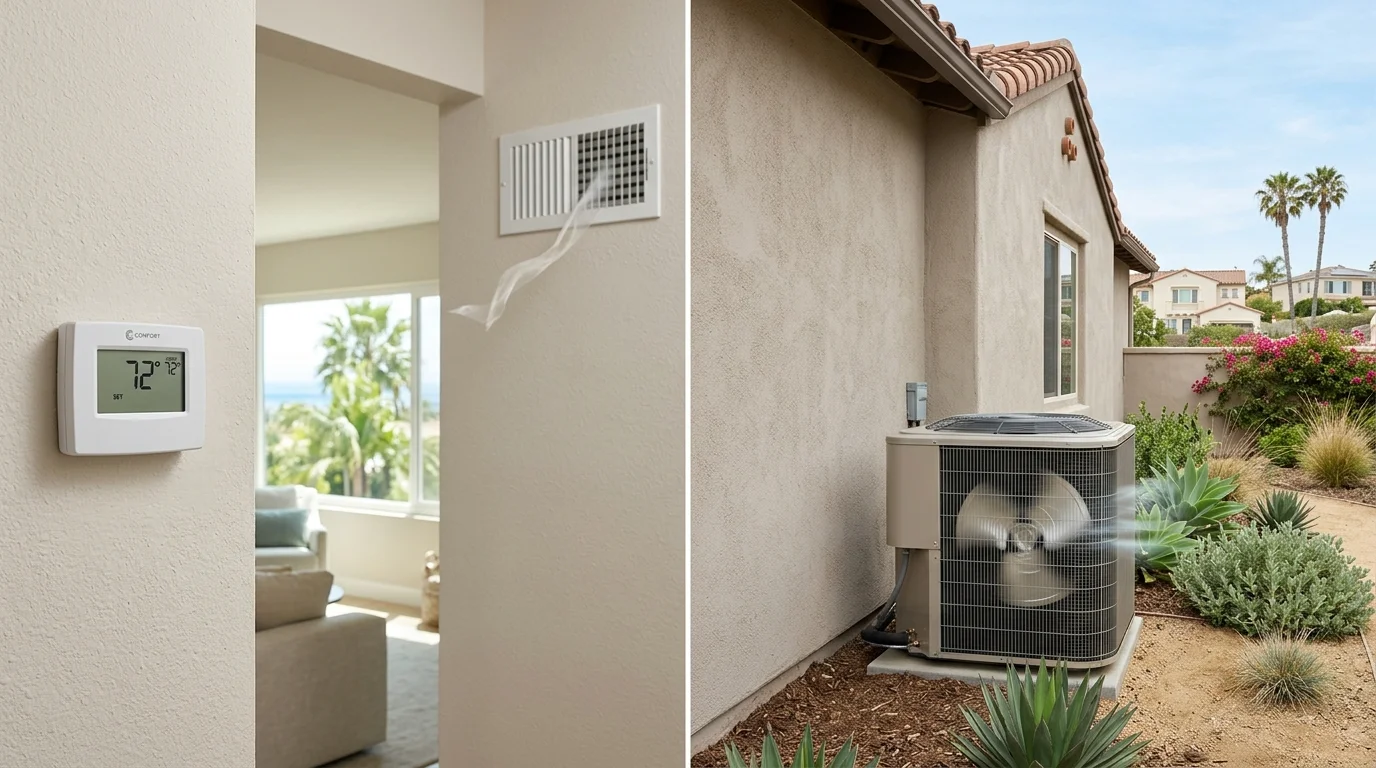
How to tell whether the fan or compressor is running
Stand still and split the system into two pieces. The indoor blower moves air through ducts, a wall cassette, or a ceiling cassette. The outdoor unit holds the compressor and the outdoor fan, usually on a pad along the house or in a side yard.
Walk to a supply register. A steady stream of air means the indoor fan is on. That does not prove the heat pump is still heating or cooling. Many thermostats let the blower run by itself after the call for heat or cool has ended.
Then step outside. Stay clear of the cabinet. Do not lift the grille. Listen. A running outdoor fan or a compressor hum means the outdoor unit is still being asked to work. If that pad is silent and only indoor air is moving, you are usually hearing the blower, not a heat pump that refuses to stop at the set point.
On a ducted house in Clairemont or Rancho Penasquitos, the air handler often sits in a garage closet or attic. You can hear that cabinet even when the outdoor unit is off. On a mini-split in a North Park condo, the indoor head is in the room. The outdoor unit may sit on a balcony or a shared walkway. Same test: indoor air versus outdoor sound.
Write down which piece was running, and for how long after the display hit the set temperature. Approximate is enough. Do not treat one observation as a diagnosis.
If both indoor and outdoor pieces keep going and rooms never catch up, that is a different complaint than a quiet pad and a fan that never stops. Mix those up and a technician starts at the wrong end of the system. Do not open electrical panels. Do not touch refrigerant lines. Looking and listening is the whole first pass.
The same split applies in cooling. A heat pump in cool mode can look like an air conditioner that keeps running after reaching the set temperature when only the blower is still on. Confirm the outdoor unit before you assume the refrigeration circuit is stuck.
When a long cycle can be normal
A heat pump is not an old oversized furnace. Many San Diego homes used to heat with short, hot bursts. A heat pump often runs longer, at a lower, steadier output. Variable-speed equipment in particular can stay on for a long stretch while it holds a room instead of slamming on and off.
Long runtimes can be normal when the house load is close to what the unit can deliver. That shows up on inland summer afternoons in El Cajon, Santee, and Escondido, when west walls and upstairs rooms keep taking heat. It also shows up on cool, damp coastal nights in Encinitas, La Jolla, or Point Loma, when the unit is heating against marine air and the house leaks.
It is not a diagnosis by itself. A unit that holds the set temperature, feels even, and then rests is doing its job even if the rest comes later than you expected. A unit that never rests and never gets there is not the same story. Do not assign a universal cycle length. Houses, ducts, sun, and equipment type all change the picture.
Some guides talk about a “20 degree rule” for heat pumps. A published standard with that name and a fixed number could not be confirmed for this page. Do not treat an internet rule as a sizing law. Licensed installers size to the house, the ducts or zones, and San Diego’s split climate, not to a catchy figure.
The same caution applies in cooling. The thermostat can first show the set number while a sun-soaked great room is still catching up, especially if the thermostat sits in a shaded hallway. Inland September heat in Chula Vista or Lakeside can keep feeding the house after the display looks “done.” Coastal marine layer can hide the opposite problem: the house feels clammy while the unit runs on.
If your old furnace cycled off fast on a 50-degree night, a heat pump that stays on longer can still be working as designed. Compare comfort and whether the displayed temperature is actually met, not how a gas furnace used to sound.
Thermostat settings that can extend operation
The first setting to read is Fan. If Fan is ON, the blower runs whenever the system has power, even after heating or cooling stops. AUTO ties the blower to the call for heat or cool. A lot of “heat pump won’t stop running” reports are the fan, not the compressor.
Mode matters. HEAT, COOL, AUTO, and any emergency-heat setting are not interchangeable. AUTO can keep hunting if the house swings between sun and shade. Emergency heat, on systems that have it, is backup heat. It is not a daily San Diego winter mode. If someone switched it during a cold snap in Ramona or the backcountry, the outdoor unit and the indoor heat source may not behave the way you expect. Leave that call to a licensed tech.
Offsets, wide night setbacks, and aggressive recovery on a smart thermostat with a heat pump can stretch a cycle. The display may already show the target while the equipment is still chasing a schedule or a remote sensor. A sensor in a cool interior hall in Mira Mesa can satisfy the control while the west bedrooms are still warm. That looks like the heat pump runs past the thermostat setting when the control is reading the wrong slice of the house.
Some of that cluster is thermostat problems that look like heat pump problems. Wiring, sensor placement, and heat-pump configuration belong in thermostat and controls work done by a licensed independent pro. Do not pull the thermostat off the wall. Do not start flipping installer menus.
Record the mode, fan setting, schedule, and any auxiliary or emergency-heat indicator. Then stop. One homeowner change at a time, and only settings you already understand, such as Fan ON to AUTO. If AUTO was already selected and the outdoor unit still never rests, you have left the “wrong fan setting” explanation behind.
Airflow problems that keep rooms from catching up
If rooms never reach the number on the glass, the equipment can keep calling. Restricted airflow is a common reason, and it is local.
Coastal filters load with salt film and household dust. Inland filters load with dry dirt, construction dust, and pollen. A packed filter makes the blower work while supply air at the register feels weak. Closed registers in unused rooms, blocked returns behind sofas, and crushed flex in a hot attic all do the same thing: the thermostat’s space lags, so the heat pump keeps running after reaching temperature on the display even though the house is not actually there.
Older East County and South Bay houses often have leaky or undersized ducts. Conditioned air dumps into a hot attic while the living room waits. A ductless head in City Heights or a National City apartment has a different pattern: a dirty indoor filter on the cassette, or a closed door that isolates the thermostat’s room from the rest of the unit.
Sun load is not a defect. A west-facing stucco wall in Chula Vista in September will keep feeding heat into the house after the thermostat first hits the set point. The unit may still have a real cooling job. That is not the same as ice on the outdoor coil, a burning smell, or a breaker that will not stay set.
You can replace or clean a user-serviceable filter if the manufacturer’s instructions say so. You cannot add refrigerant, open the electrical compartment, or “top off” a system. Those are licensed tasks. Weak airflow after a filter change is heat pump repair territory for an independent contractor, not a weekend experiment.
Do not diagnose a refrigerant leak from runtime alone. Low charge is something a licensed tech tests with gauges and procedures you should not improvise. A long cycle plus weak registers plus a dirty filter is still first an airflow story.
What to record before changing any controls
Before you change anything else, write a short log. Date, time, and whether you were heating or cooling. Indoor set point and the temperature the thermostat displayed. Outdoor weather in plain words: marine layer in Pacific Beach, hot and still in Lakeside, windy Santa Ana.
Note which rooms felt behind. Note Fan ON or AUTO. Note whether the outdoor unit was audible. Note any ice, dripping, burning smell, or error code on the thermostat or indoor head. Note how long the air kept moving after the display reached the set temperature. Approximate is fine. Do not invent a precise “normal” cycle as a rule.
Photograph the thermostat screen. Keep names, addresses, and account numbers out of the frame. That picture plus your log is what a licensed tech can use without guessing.
Change one homeowner setting at most, then wait through another cycle. If you toggle fan, schedule, and mode all at once, nobody can tell what mattered.
Do not reset breakers as a habit. If a breaker has tripped, stop and call a licensed contractor. Do not hose the outdoor coil with the power on. Do not hold a contactor closed. You are collecting symptoms, not performing service.
If two floors disagree, say so. A Mission Hills bungalow with one thermostat is a different map than a two-story Santee tract house with a hot upstairs. The log should name the rooms, not just “the house.”
When a technician should test the system
Call for testing when the house never reaches the set temperature, when the outdoor unit runs with no real heating or cooling at the register, or when you see ice, smell burning, or hear grinding. Constant operation plus comfort is a conversation. Constant operation plus a house that never catches up is a service call.
A licensed independent HVAC contractor tests controls, airflow, and the refrigeration circuit with tools you should not improvise. Relay, capacitor, and wiring faults are not visual DIY checks. Refrigerant handling is licensed work.
Confirm the contractor’s license on the CSLB license lookup before anyone opens a panel. California treats unlicensed contracting as a misdemeanor unless a narrow exemption applies. Heat Pro SD matches you with licensed independent pros and does not perform the physical work.
If the issue looks like a control, sensor, or thermostat configuration, say that up front. If it looks like capacity, ducts, or the outdoor unit, say that too. Your log keeps the visit from turning into a fishing trip.
Do not wait on a burning smell, a breaker that will not hold, or ice building on the outdoor coil in cooling weather. Those are stop-and-call conditions. A heat pump that seems like it is constantly running on a mild Encinitas night, with even rooms and a clean filter, can wait for a scheduled test. A heat pump that runs past every set point while upstairs bedrooms in El Cajon never cool is not a wait-and-see filter issue.
When to call us
If Fan is already AUTO, the filter is clean, and the heat pump still runs after the house should be satisfied, it is time for a licensed Heat Pump Installation or repair pro to test the system. Heat Pro SD does not send a crew of its own. Call us at (858) 400-4374 and we’ll connect you with a licensed local HVAC contractor.