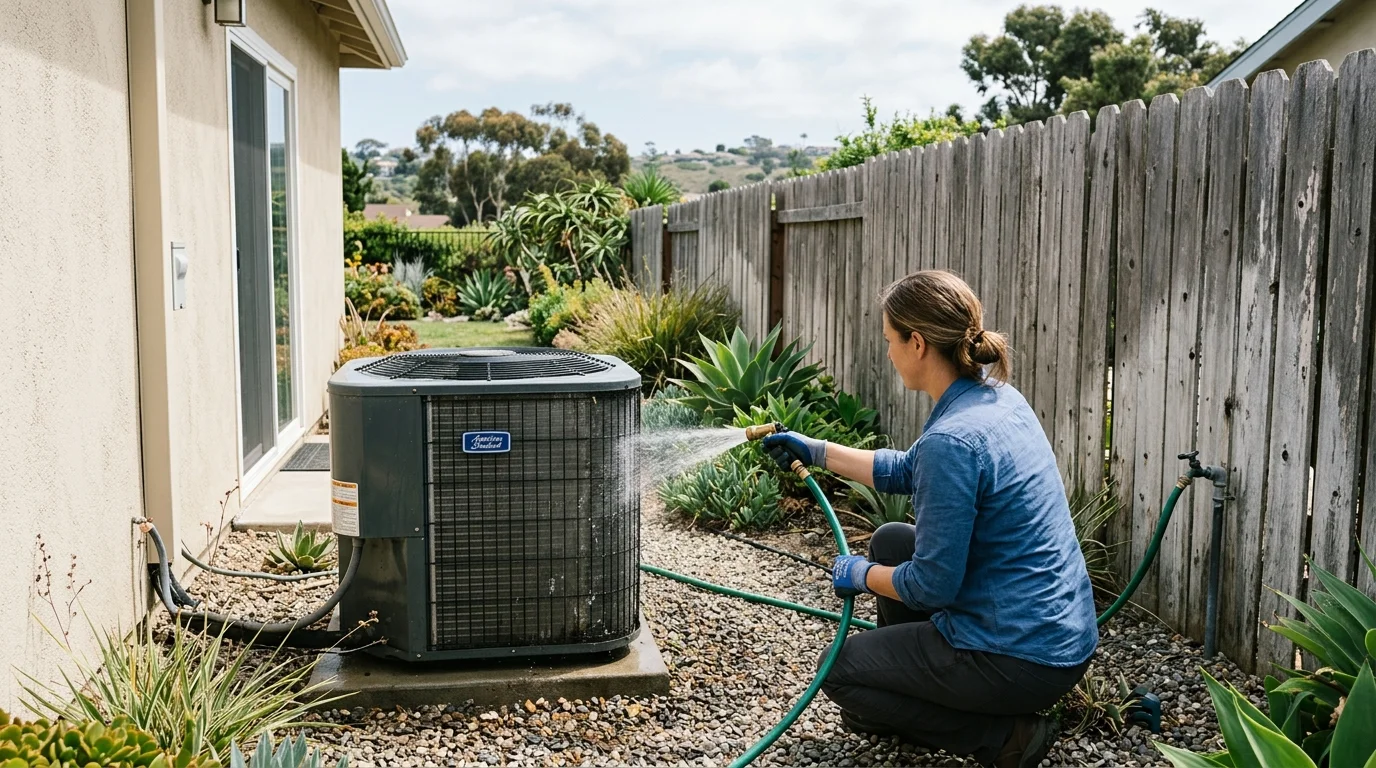
Start with the instructions for your exact heat pump model. Follow its shutdown procedure, remove accessible loose debris, and rinse the exterior coil only when the manual permits it. Stop if cleaning would require opening a panel, handling wiring, or reaching the fan.
Why the outdoor coil matters more near the coast
San Diego County covers very different settings. An outdoor unit near the coast can collect a different mix of residue than one in East County. A unit beside a Point Loma fence also faces different surroundings than equipment near an open El Cajon yard.
Use what you can see instead of following a countywide cleaning schedule. Look through the outer guard without removing it. Note visible dust, leaves, plant growth, landscape clippings, and surface residue. Check each accessible side because buildup may not be even.
Pay close attention to units in Oceanside, Encinitas, Imperial Beach, and other coastal communities. If you see a film that doesn’t release with the method permitted by the manufacturer, don’t move straight to stronger chemicals. The equipment manual identifies suitable cleaning products and restrictions for that model.
Location also changes what reaches the cabinet. Nearby irrigation, mulch, vines, pets, and active landscaping can affect its condition. These are property-specific issues, so the right cleaning moment depends on inspection.
Our guide to coastal and inland San Diego heat pumps explains why location belongs in maintenance planning. The main lesson is simple: inspect the equipment you have, in the setting where it operates. Don’t assume advice for another neighborhood or another model applies unchanged.
Shut the power off first, and how to be sure it is off
Don’t begin with a hose or cleaning tool. Find the manufacturer’s shutdown directions for your model and follow them in order. The manual may be printed, stored near the indoor equipment, or available through the manufacturer using the model number.
Turning the thermostat off isn’t a substitute for the prescribed electrical shutdown. Your system may have more than one control or power point. Labels can also be unclear, especially after electrical or HVAC changes.
Don’t guess which breaker or disconnect belongs to the unit. If the labels don’t clearly match the equipment, stop and contact a licensed HVAC contractor. A contractor can identify the correct controls and tell you whether the labeling needs attention.
After following the manufacturer’s procedure, don’t open electrical compartments to test your work. Don’t touch wiring, capacitors, terminals, or internal controls. Those areas aren’t part of routine exterior cleaning.
Make the same decision if you find a damaged cover, loose conduit, exposed wire, scorch mark, or water inside an electrical area. Leave the equipment alone and arrange an inspection.
The goal isn’t to prove that every internal component lacks power. A homeowner can’t establish that from appearance alone. The practical boundary is to follow the model-specific instructions and avoid internal access. If you can’t confidently complete those steps, leave the cleaning to a licensed pro.
Clearing debris and plant growth around the unit
Begin with material that’s outside the cabinet. Pick up loose leaves, fallen blossoms, small twigs, and landscape clippings from the surrounding area. Work slowly so you don’t push debris through the guard.
Check the base and the space between the equipment and nearby walls. In compact San Diego lots, an outdoor unit may sit beside a fence, side gate, patio, or planting bed. Remove only items you can reach without leaning on the cabinet or opening a panel.
Trim plant growth that touches the unit. Don’t pull a vine through the guard if it has become tangled inside. Cutting the accessible growth away and leaving the trapped section for a technician avoids dragging it across delicate parts.
Don’t choose a clearance measurement from a general web guide. Your manufacturer sets the required space around the model, and that figure belongs in its installation manual. Compare the current landscaping with that document. If an HOA controls visible equipment or landscaping, request its current standard before changing the area.
Use your hands or a soft tool only on the surrounding ground. Don’t scrape the coil surface or poke objects between the guard openings. If packed debris sits behind a fixed panel, that’s no longer an exterior cleanup.
Outdoor cleanup should also include a quick visual check. A cabinet that appears tilted, loose, or physically damaged needs professional attention. Don’t attempt to level, lift, or reposition connected equipment.
Rinsing the coil the safe way
Confirm first that the manufacturer permits homeowner rinsing. The manual controls the method, direction, and products for your unit. If those details aren’t available, arrange a maintenance tune-up instead of experimenting.
When rinsing is permitted, use a garden hose with gentle water flow. Keep the nozzle back from the coil and let water carry loose surface material away. Don’t press the nozzle against the guard or fins.
Avoid pressure washers unless the manufacturer expressly allows one for that model. Don’t substitute household detergents, solvents, bleach, or an unlabeled coil product. A cleaner marketed for HVAC equipment still may not match your unit’s instructions.
Keep water away from electrical compartments, controls, wiring entries, and damaged cabinet openings. Don’t aim water into the top fan area. Follow the manual’s stated rinse direction rather than assuming water can be applied from any side.
Pause if the runoff can’t drain away from the unit. Standing water, unstable soil, or a visibly shifting equipment base calls for professional review. Don’t dig beneath the unit or move its support to create drainage.
After rinsing, leave covers and guards in place. Don’t wipe the fins with a towel or brush. Let accessible surfaces drain, then inspect from outside for remaining patches.
One gentle pass is enough for a homeowner check. Material that stays attached may require panel access, a model-specific cleaner, or a technician’s judgment. More force isn’t the answer. Record the model number and describe what remains when arranging service.
Fin damage: what you can straighten and what you cannot
Coil fins are the thin metal surfaces visible behind the outer guard. Their exact shape, spacing, and access vary by equipment. That means there isn’t one fin-straightening method that fits every heat pump.
Start with observation. Look across the coil from different angles without removing panels. Note whether the surface appears generally even or whether one area looks folded, crushed, or scraped. A photo can help a technician understand the location before service.
Don’t use a screwdriver, knife, stiff brush, or improvised pick. Don’t push a tool through the guard. Avoid a generic fin comb unless your manufacturer identifies the right procedure and you know the tool matches the coil.
Even a small bent area doesn’t automatically need homeowner correction. Leave it alone if the manual doesn’t provide a clear method. A licensed technician can decide whether it affects service or is only cosmetic.
Stop immediately if you see a puncture, oily-looking residue, damaged tubing, or a section that appears crushed beneath the cabinet. Don’t press, wipe, or probe the area. Describe what you saw when contacting a contractor.
The same boundary applies when fins sit behind a panel. Removing that panel turns a simple exterior cleanup into internal service. Keep the cabinet assembled and let a licensed HVAC contractor handle inaccessible damage.
Where the homeowner job stops and a technician takes over
A homeowner cleanup ends at the accessible exterior. It doesn’t include opening service panels, moving the unit, handling electrical parts, cleaning internal components, or diagnosing operating problems. Those tasks belong with a licensed HVAC contractor.
Call a pro when the manual doesn’t permit the cleaning method you planned. Do the same when debris is trapped behind a fixed guard, residue remains after an allowed rinse, or plant growth has entered the cabinet.
Cleaning also won’t resolve every symptom. If the system isn’t operating normally, don’t keep washing the outdoor unit in search of a fix. Arrange an inspection and explain what changed, when you noticed it, and what exterior cleaning you completed.
Keep the model number, manual, and any photos together. Tell the contractor about nearby irrigation, recent landscaping, visible damage, or persistent buildup. That context helps the contractor inspect the right areas without relying on guesses.
For broader planning, see our San Diego heat pump maintenance guide. It separates routine homeowner checks from work that needs professional tools or access.
Before hiring, confirm the contractor’s status through the California Contractors State License Board. Heat Pro SD matches homeowners with licensed independent local pros. The matched contractor performs the inspection, cleaning, repair, or other physical work.
When to call us
Call when cleaning requires panel removal, electrical access, internal coil work, or a diagnosis. A licensed pro should also inspect visible damage or buildup that an allowed gentle rinse doesn’t remove. Call us at (858) 400-4374 and we’ll connect you with a licensed local HVAC contractor.