A mini split can sit only as far from the condenser as that model’s published line-set limit allows. There is no San Diego County maximum, and there is no universal length that covers every brand. The indoor head you want and the outdoor pad that actually fits the lot have to be planned as one route, then checked against the current equipment manual by a licensed independent pro.
What line-set distance actually limits
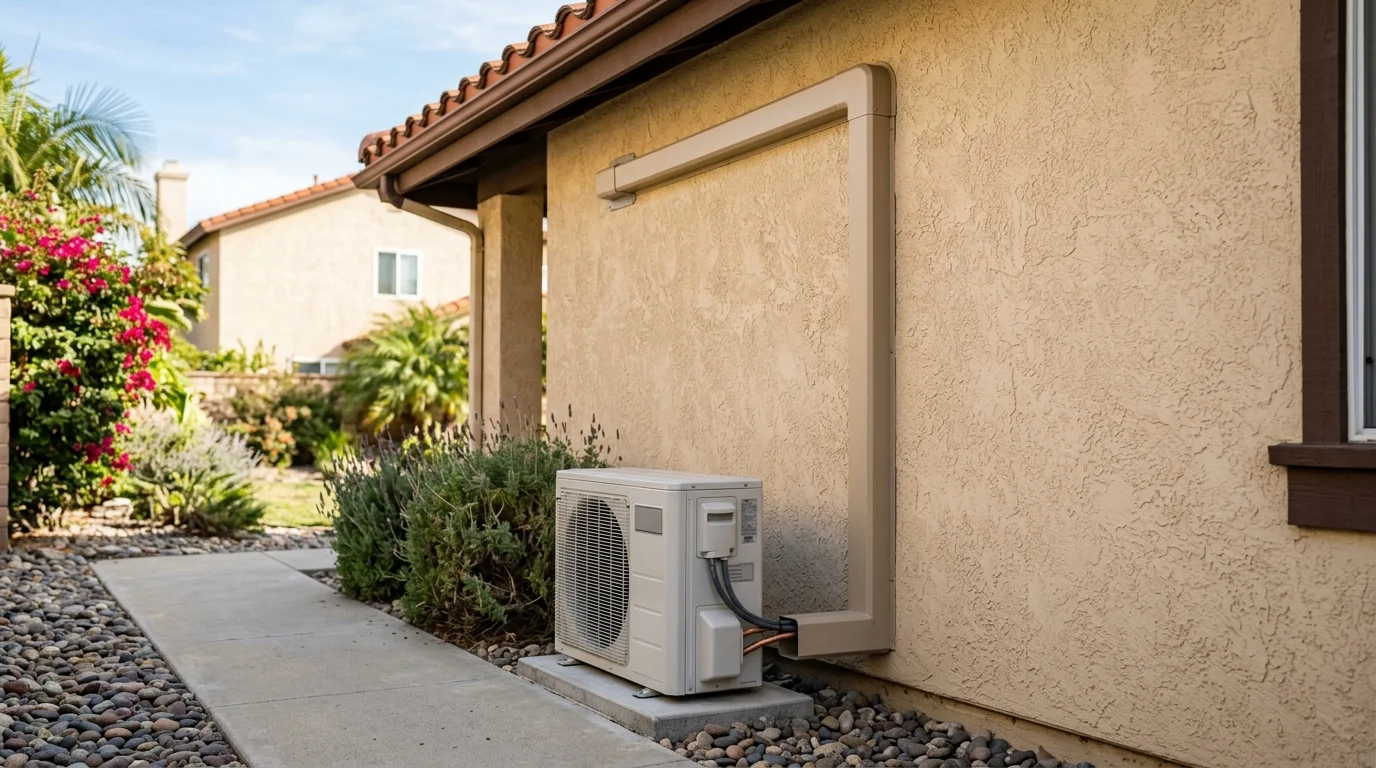
The line set is the insulated copper pair that carries refrigerant between the indoor head and the outdoor unit. When someone asks how far a mini split can be from the condenser, they are asking about that pipe, plus the vertical rise, plus the extra length hidden in elbows. The number that matters is the length of the route as built, not the tape measure from the bedroom window to the side yard in a straight line.
That length limits the refrigeration circuit. Oil has to return to the compressor. Refrigerant has to arrive in the state the indoor coil expects. A run that is too long, too tall, or too bent for the model can leave the head short on capacity, especially on a heating morning in Ramona or Alpine when the outdoor unit is already working harder than it does on the coast. The outdoor unit can hunt, short-cycle, or sound unhappy. None of that is a personality quirk of the house. It is a piping design that left the factory envelope.
The line set is also not the only path that has to close. Control wiring follows the same wall. Condensate has to fall to a legal drain or get a pump. On a Mission Hills or Mount Helix hillside, the drain path can kill a placement the copper would have survived. On a Chula Vista or National City ADU, the drain may have to clear a slab, a fence, and a neighbor’s grade. Plan refrigerant, wiring, and condensate together.
Do not treat a number from a forum as the limit. Manufacturers publish different maximum equivalent lengths, different height differences, and different extra-charge rules by model and by year. A single-zone wall head and a multi-zone system with a branch box are not the same circuit. If a quote names one maximum for every ductless job in the county, that quote is guessing.
Why indoor and outdoor placement have to be planned together
People pick the bedroom first, then hunt for a pad. That sequence is how a house ends up with a head in the right room and a condenser that cannot sit close enough, legally or physically.
Outdoor placement in this county is already a negotiation. Coastal north county lots in Encinitas, Carlsbad, and Solana Beach are tight. HOA rules stack on city setbacks, and a west-facing wall in salt air is a different outdoor life than a shaded east side. Inland north county in Escondido, San Marcos, and Vista wants airflow and afternoon shade more than a pretty view of the cabinet. Older bungalows in North Park, South Park, and Golden Hill often have a skinny side yard and an alley. East County hillside pads in Lakeside, Alpine, and El Cajon can look close on a plot map and still be a long vertical drop in real pipe. Outdoor heat pump unit placement in San Diego is its own decision. It cannot be an afterthought once the indoor heads are promised.
Indoor placement is a second map. A wall head wants clear throw across the room. A ceiling cassette wants joist space. A floor console wants a free wall that is not a slider to the patio. Those rooms almost never sit at the same height as the quietest legal pad.
The honest way to design ductless mini-split installation here is to freeze both ends in the same walkthrough. Stand at the pad options, stand in the rooms, then draw the pipe on the actual walls. If the drawn path blows the model’s limit, you move a head, you move the pad, or you change the equipment. You do not “just add more copper.”
HOA and coastal overlay reviews in Coronado, Del Mar, and parts of La Jolla can force the condenser onto a rear elevation you did not start with. That is a line-set problem dressed as an aesthetics problem. Catch it before the equipment is ordered. A Encinitas courtyard and an El Cajon ranch do not share the same outdoor options, the same heat load, or the same pipe story. A page that treated them as the same house would be guessing.
How two-story and long ranch layouts raise the question
Two-story tract homes in Mira Mesa, Scripps Ranch, Otay Ranch, and Carmel Valley put upstairs bedrooms far from the quietest backyard pad. Vertical rise is often the tighter published limit. A run that looks legal across the yard can still exceed the model’s maximum lift from the outdoor unit up to a second-floor head. The reverse happens too: a condenser on a garage roof or a deck well above a downstairs office.
Long ranch houses in Rancho Santa Fe, Valley Center, Fallbrook, and parts of Bonsall create the other problem. One outdoor unit at the garage end and a far bedroom, office, or casita at the other. The pipe follows the eave and the jogs around windows, so the real length is the building perimeter, not the diagonal through the living room.
Split-level and canyon lots in La Jolla, Del Mar, and Mount Helix add stairs of grade that do not show on a floor plan. A “short” side-yard pad can sit a full story below the indoor head once the slope is counted. Inland heat does not change the copper limit, but it does change how much you feel a derated head on a September afternoon in El Cajon compared with a marine-layer afternoon in Encinitas.
Garage conversions and backyard ADUs in City Heights, Logan Heights, and Imperial Beach add a second conditioned space that may share a wall with nothing useful. The temptation is one outdoor unit feeding both the house and the ADU. That is a multi-zone system question and a line-set question at the same time. Branch piping still has to stay inside each indoor unit’s published range from the outdoor unit or from the branch box, depending on the model.
Manufactured homes and older East County stucco houses sometimes have no attic chase. Surface line-hide covers along the wall are common. Covers do not shorten the run. They only hide it. Measure the cover path, including every down-and-around at a window.
What belongs in the manufacturer limit, not a guess
The current installation manual for the exact outdoor unit and indoor heads is the document that answers how far. It typically publishes a maximum pipe length, a maximum height difference, sometimes a minimum length, and a factory charge that covers a stated length. Some models require additional refrigerant above that length. The extra amount, if any, lives in that manual. It is not a round number from memory.
Equivalent length matters. Elbows, flare joints, and branch fittings count as extra length in many manuals. A pretty route with six 90-degree turns can be “longer” than an uglier straight shot. That is why a licensed installer measures the route they will actually build, then compares it to the pages in the box, not to last year’s brochure.
Capacity tables in the same manual sometimes derate the indoor head as the pipe gets longer. A head that looks correctly sized on a load calculation can underperform at the far end of a ranch if that derate is ignored. Ask to see the table. Ask which length the quote assumed.
Warranty language sits with the manufacturer and with the installing contractor. Heat Pro SD matches homeowners with licensed independent pros and performs no physical work. We do not install the system, and we do not warrant it. If a manual says the warranty needs a recorded pipe length and a correct charge, that belongs in the job file.
Do not use a screenshot from a different chassis. Line-set rules change when a model changes refrigerant or cabinet. The unit on the truck is the one whose manual counts. If the only way to make the rooms work is to exceed the published limit, the answer is different equipment or a different outdoor count, not a longer pipe.
Confirm the contractor on the CSLB license lookup. Unlicensed contracting is a misdemeanor under California Business and Professions Code section 7028 unless an exemption applies. The small-job exemption in section 7048 is only for work under $1,000 (effective January 1, 2026) that also does not need a permit. Splitting a job to stay under that figure does not create the exemption. A heat pump project that needs a permit should be treated as licensed contractor work. Confirm the permit path with the city or county and with the pro who will pull it. Heat Pro SD does not pull permits.
When a second outdoor unit enters the comparison
This page is about pipe run. How many outdoor units to buy is a different question, and it is covered in one mini-split outdoor unit or two. Keep them separate.
A second condenser shows up when the rooms you want sit on opposite ends of a long house, on two floors with a lift problem, or in a house-plus-ADU pair that would force one oversized run. Two shorter, legal line sets can be cleaner than one heroic run that lives near a model’s ceiling. That is especially true on a deep lot in Rancho Peñasquitos or a house that already spent its quiet pad on the main bedroom.
A multi-zone outdoor unit can still lose if the farthest head sits beyond that chassis’s published limit. Adding indoor heads does not stretch copper. It can make the farthest head worse if the piping tree gets longer. The branch box does not erase the manual.
Noise and neighbor lines matter on small lots in South Park, Ocean Beach, and Imperial Beach. Two smaller pads in two quieter corners can beat one large unit that only fits by a bedroom window. That is placement, capacity, and line-set length in the same conversation.
Do not compare those layouts on a lump sum with no drawing. Pricing is a quote from the matched pro for the equipment and the route they drew. Heat Pro SD does not publish job prices. Compare proposals on the documented pipe path, the models, and the manual limits sitting next to those numbers.
What the installation proposal should document
A serious proposal for San Diego County names the indoor rooms, the outdoor pad, the manufacturer and model, and the line-set path in feet of actual route plus the vertical rise. It cites the current manual’s maximums next to those measured numbers. If the model needs extra charge above a factory length, the proposal says so and points at the manual, not at a habit.
It should show line-hide or chase, condensate (gravity or pump), and the electrical path. It should name who pulls the permit. The licensed contractor does that work. Heat Pro SD does not.
Ask for the CSLB license number and look it up on the state site before you sign. Ask whether the outdoor location already survived HOA or city comments, especially near the coast. Ask what happens if an inspector or an HOA forces the pad to move after the equipment is ordered. That move can blow a line-set plan that looked fine on paper.
If two layouts are in play (one outdoor versus two, or a multi-zone versus two singles), put both on paper with both pipe maps. The cheaper drawing is not always the shorter copper, and the shorter copper is not always the quieter pad. The homeowner’s job is to make the matched pro show the route, the rise, and the page in the manual that allows it.
When to call us
If you are placing indoor heads and an outdoor pad on a two-story, a long ranch, an ADU, or a hillside lot in San Diego County, the line-set limit has to be in the design before equipment hits the driveway. Call us at (858) 400-4374 and we’ll connect you with a licensed local HVAC contractor.