The outdoor unit behind a Santee or Escondido house can look broken at 2 a.m. The fan stops. You hear a short hiss. A thin film of frost starts to clear. That is often the heat pump defrost cycle, a built-in heating mode, not a failure. Most air-source heat pumps have one. It exists so the outdoor coil can keep pulling heat from San Diego night air after moisture has started to freeze on the fins.
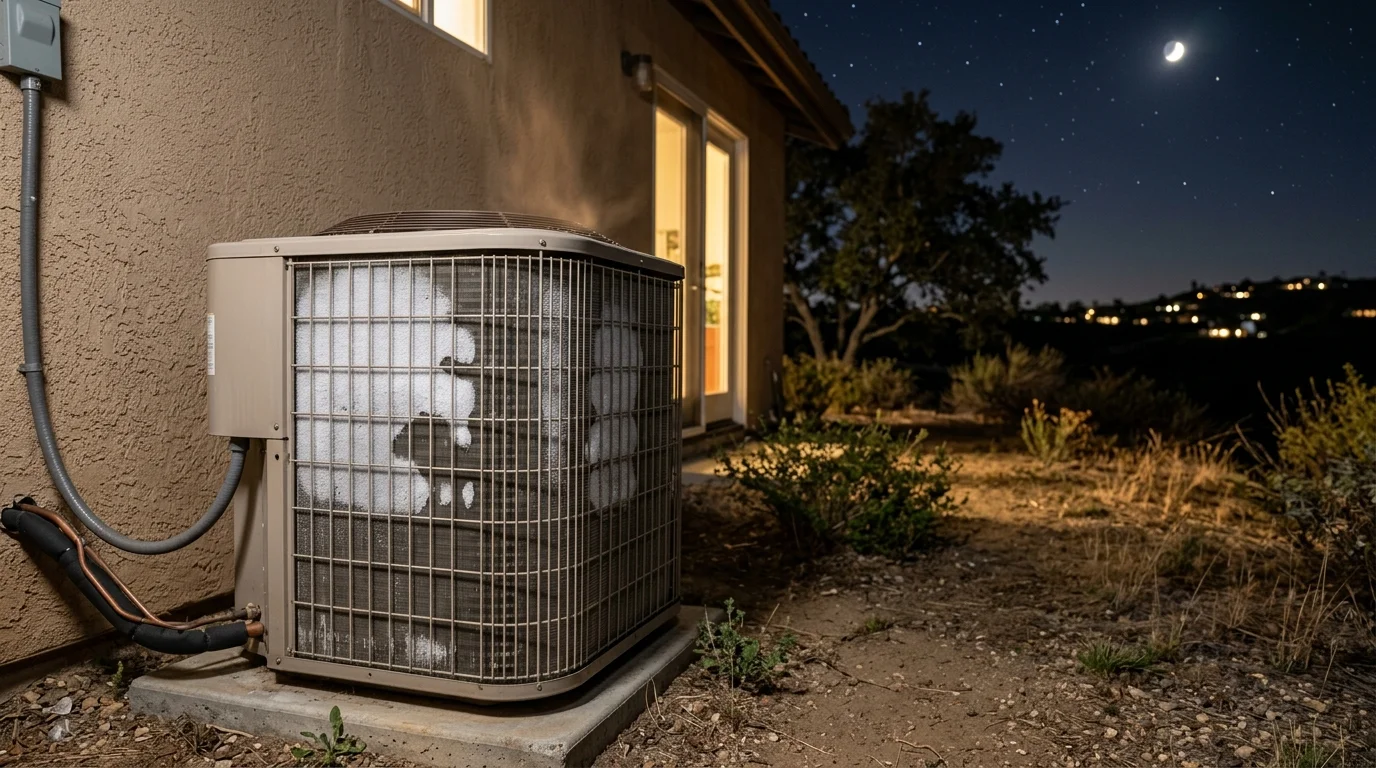
What a defrost cycle looks and sounds like
Yes, heat pumps have a defrost cycle. When the system is heating, the outdoor coil runs colder than the night air. Moisture on the fins can frost even when the street is not in a freeze warning. A yard in Ocean Beach can sit in the upper 40s and still be wet. A pad in Alpine can be colder and drier. Either way, frost blocks airflow across the coil. The unit is designed to clear that frost on its own.
Heat pump defrost mode in San Diego is a short reverse of heating. Warm refrigerant is sent through the outdoor coil so the frost can melt and drain. You may hear the reversing valve shift. That can sound like a hiss, a clunk, or a brief whoosh. The compressor may sound louder for a bit. A low hum or buzz can show up too. Those sounds, on their own, do not prove a breakdown.
The outdoor fan often stops. That is the honest answer to whether the fan runs during the defrost cycle. On many units it does not, on purpose. Still air lets the coil warm. When the cycle ends, the fan should start again and heating should resume. If the blades never move after the pause, that is no longer a finished cycle.
Inside, supply air can feel cooler for a few minutes. The system is briefly using heat from the house to warm the outdoor coil. If the home has backup heat, that heat may come on so rooms do not drop. Many San Diego houses have no gas furnace behind the heat pump. In those homes the pause is more noticeable. Then the unit should return to heating.
A light plume at the cabinet is melted frost leaving as vapor. That is moisture, not smoke. Stay with this page for the operating mode. A thin plume during a clearing coil is part of the cycle, not a separate failure.
Do not treat a summer cooling call as the same event. People search why an AC keeps going into defrost mode because a heat pump is one machine for both seasons. Defrost belongs to heating. A coil icing while the thermostat is set to cool is a different problem.
How to tell a short defrost from ice that stays
A short defrost leaves a thin film, then a wet coil, then visible metal. Water may drip from the base. The outdoor fan returns. Indoor air warms back up. If you came outside asking why your heat pump is defrosting, that pattern is the answer: the control saw frost risk and ran the mode it was built to run.
Ice that stays is thicker, and it is still there after the unit has gone back to what looks like heating. Sheets on the fins, a frozen fan ring, or a block at the base are not a finished cycle. That pattern belongs on our page about ice on an outdoor heat pump in San Diego. This page is the operating mode. That page is frost that does not leave.
Watch one full cycle from a few steps away. Note whether the fan stopped and then restarted. Note whether the hiss was once, or whether the unit keeps slamming in and out of reverse. Repeated reverse without a clear coil is not a healthy pattern. A single quiet pause on a cold inland night often is.
Do not time the unit against a number you found online. Models differ. Controls differ. A timer-based board and a demand-defrost board do not behave the same. No universal runtime belongs here, because we cannot verify one figure for every brand in the county. What you can verify is the result. The coil should not stay armored in ice.
Leaves, eucalyptus drop, and bougainvillea against the cabinet can make frost linger even when the cycle is trying. A unit jammed against a stucco wall in a side yard gets less air than one with open sky. That is an observation from the pad, not a reason to pull the cover.
If heating never returns, or rooms keep sliding down after several cycles, stop guessing. That is licensed HVAC work, not a hose and a flashlight.
Why inland and backcountry nights differ from the coast
San Diego County is not one night climate. A heat pump in Encinitas and a heat pump in Julian are not fighting the same air.
Along the coast, from Imperial Beach through La Jolla and up to Oceanside, nights are milder and wetter. Marine air holds moisture. The coil can frost even when the patio feels only cool, not bitter. October’s first heating window often starts here as a damp night in the 50s, not a freeze. Defrost still shows up because wet fins ice at coil temperature, which is colder than the air you feel standing next to the unit.
Inland valleys, El Cajon, Santee, Escondido, and San Marcos, drop harder after sunset. Heat leaves tile roofs and dry dirt fast. A backyard in Lakeside can sit well below the coast on the same calendar night. Frost there is more about the coil getting cold than about fog. You may hear more defrost events on those nights even with less marine haze.
The backcountry, Ramona, Alpine, Descanso, Jamul, Valley Center, and the Julian grade, can actually freeze. Those nights are why people ask whether heat pumps work on cold San Diego nights. They do. The defrost cycle is part of how they keep working. A unit in a shaded canyon or a north side yard in Alpine will frost more than the same model on a windy ridge.
Santa Ana nights are the dry exception. Downslope air cuts humidity. Frost is less likely until the marine layer returns. After a Santa Ana breaks and a cool west wind fills the inland valleys, defrost can return the same week. That swing is normal for East County. It is not a new defect in the machine.
A condo courtyard in Mission Valley can behave more like a canyon than a coast house. Tall buildings cut wind. Irrigation runs at night. The coil sits in a wet pocket. Local placement matters as much as the city name on the water bill. A Kensington or North Park side yard that never sees sun will hold damp air longer than a west-facing pad in Clairemont.
None of this makes every defrost a fault. It means the same model will cycle differently in Pacific Beach than it will in Ramona. If you moved from the coast to East County, the night sounds will change. That is geography.
What you can observe from a safe distance
Stand back. Keep the electrical panel closed. Do not remove the louvered cover. Do not stick a tool in the fins. Do not pour hot water on the coil. Those moves bend fins, risk shock, and can crack a hot coil. Heat Pro SD does not perform that work, and a homeowner should not either.
From a few steps away, you can see the fan. You can see whether frost is a light film or a solid shell. You can hear the valve shift. You can look for debris around the pad: leaves, a fallen avocado branch, a ball, a hose coiled against the cabinet. You can see whether irrigation is soaking the unit every night.
You can check the indoor filter if you already know how to slide that rack, with the system off. A packed filter is a whole-system airflow problem. It is not a reason to open the outdoor unit.
Use your phone for notes, not as a flashlight inside the cabinet. Write down the city, about what time, whether the outdoor fan stopped, whether it restarted, whether ice remained, and whether indoor air stayed cool after the pause. That list helps a licensed tech more than a dark video of the side yard.
If the unit sits in standing water from a blocked drain or a sloped pad, stay out of the water. Call a licensed contractor. Heat Pro SD matches homeowners with licensed independent HVAC pros. We send no crew of our own and we do no physical repair.
Clearance around the cabinet is a visual check only. Do not start cutting irrigation or pulling the disconnect because a blog told you a number of inches. Brands differ. The installer who set the pad had a layout. A tech on a heat pump inspection can say whether the unit can breathe.
When the system should stay off
If you are watching a thin film clear, leave the thermostat in heat and let the cycle finish. Switching the system off in the middle of defrost can leave the coil wet and half frozen. The next start then fights a mess the cycle was already handling.
Leave the system off when the coil is a solid block after the unit has had a chance to run its cycle, and heating has not returned. Running all night against a locked fan or a fully iced coil is not a homeowner experiment. Set the thermostat off. Do not start flipping the outdoor disconnect unless a licensed tech asks you to isolate power. Do not open the panel.
Leave it off if you smell burning, see sparks, or hear grinding or scraping that does not match a short hiss. Those are not defrost sounds. Stay clear and get a licensed HVAC contractor on heat pump repair.
Leave it off if someone has already poured water on the unit, or if the cabinet is wet from a failed garden experiment. Water and live equipment are a tech’s problem, not a second try with a hose.
Emergency heat on the thermostat is not a defrost tool. It is indoor backup heat on systems that have it. It does not melt the outdoor coil. Do not sit on emergency heat as a workaround while ice grows outside. That is a comfort bandage, and it is not the cycle.
If you are not sure which case you are in, treat thick ice that stays as off-and-call. Treat a short, quiet pause with a clearing coil as let-it-finish. Guessing in between is how people damage a reversing valve or a fan motor.
What a technician should test if defrost never finishes
A licensed HVAC contractor is the person who opens the unit. Confirm the license on the CSLB license check before work starts. Heat Pro SD is a referral service. We do not hold the trade license and we do not perform the repair. The pros we connect you with are licensed and insured.
The tech should verify that the outdoor fan actually restarts when defrost ends. A fan that stays dead after the coil warms is a motor, capacitor, or control issue, not a long cycle.
They should test the coil sensor or defrost thermostat and, on demand-defrost boards, the outdoor air sensor. A sensor in the wrong spot, coated in dirt, or reading wild will start or skip cycles for no good reason. They should not guess from the sidewalk.
They should watch the reversing valve. Defrost needs that valve to shift and then shift back. A valve that sticks can leave the system in a cooling-like state on a heating night. That is one reason indoor air stays cool after the pause should have ended.
They should check airflow across the outdoor coil: bent fins, packed lint, a vine, a fence too close, a dog house shoved against the intake. They should check indoor airflow too, because a starved return can throw the whole circuit off. Refrigerant charge is a licensed measurement. It is not a homeowner add-up. If charge is on the list, the tech measures it with the manufacturer’s chart, not by feel.
They should read the control board’s defrost logic. Some boards use time and temperature. Some use demand. A timer left on an aggressive setting will look like too much defrost. That is a setup question, not a reason to replace the unit on the first visit.
They should confirm the system is in heat, not in a cooling call from a bad thermostat or a wrong mode. Thermostat mix-ups mimic defrost because the outdoor unit is reversing for the wrong season.
Ask for findings in plain language: what they tested, what failed, what they recommend, and whether the work needs a permit. California treats contracting as licensed work. Unlicensed contracting is a misdemeanor under Business and Professions Code section 7028. Do not invent a fine. Check the license.
When to call us
If the cycle never finishes, ice stays on the coil, or the outdoor fan never restarts, that is licensed heat pump work, not a night of watching the pad. Call us at (858) 400-4374 and we’ll connect you with a licensed local HVAC contractor.