A white film on the outdoor coil after a still inland night is a common San Diego County sight. A hard shell of ice that is still there after lunch is a different signal. Both look like ice on a heat pump outdoor unit, so the first job is to tell them apart from a few steps away.
What ice on the outdoor unit can look like
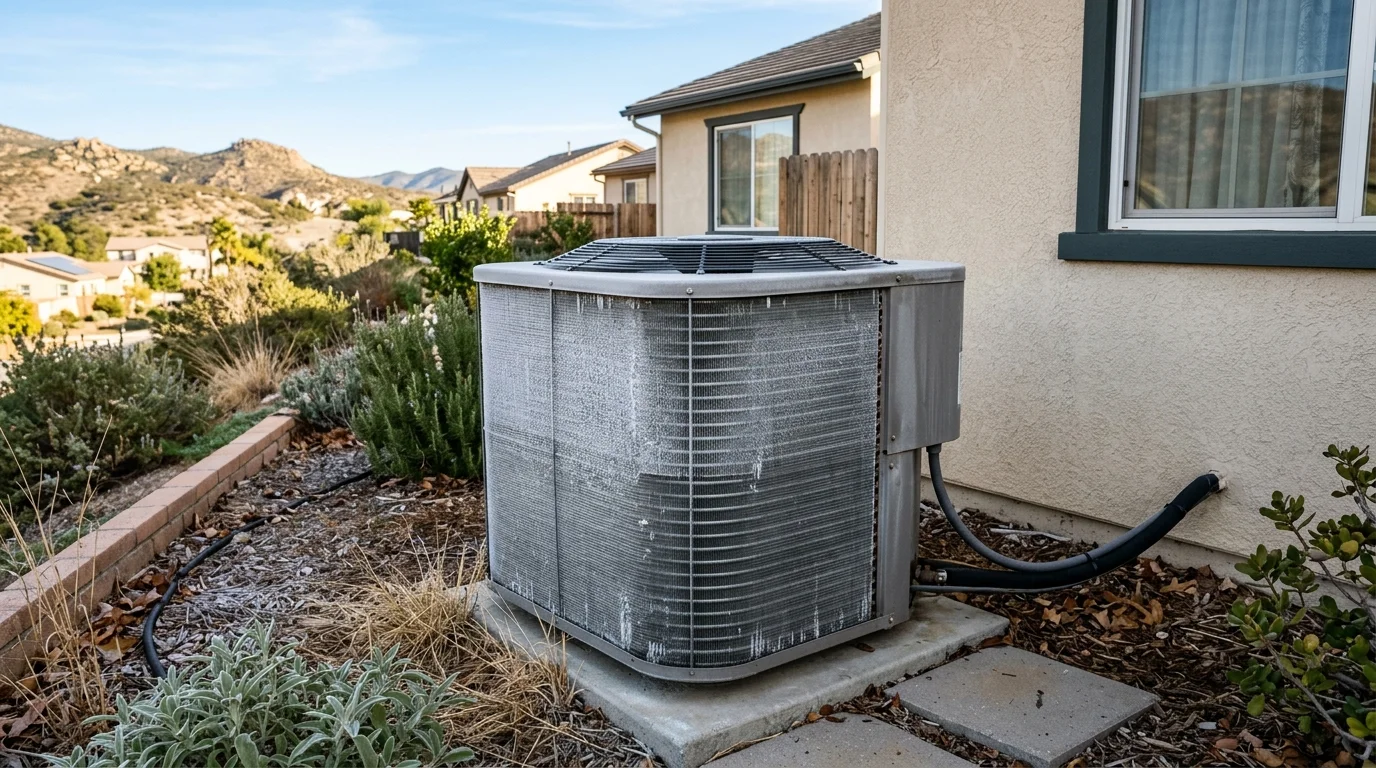
Ice on the cabinet is not one picture. In Encinitas or Pacific Beach it often shows up as a dull, even frost on the coil fins after a damp night. In Ramona, Alpine, or Julian it can look thicker, with white ridges on the fins and a crust along the top grate. Same county. Different outdoor unit.
A light frost is thin. You can still see the metal lines of the coil through it. It sits on the fins, not in a solid block. It may be heavier on the side that faces open air, and lighter on the side against a wall. By late morning it often looks wet, then gone.
A heavier freeze looks opaque. The fins disappear under a sheet. Ice can bridge from coil to coil, fill the gaps the fan needs, or hang from the discharge grille like a lid. You may also see ice on the copper lines, on the plastic fan guard, or in a ring on the pad. That is a heat pump icing up, not a dusting.
Watch where the ice sits. Frost on the coil face is the usual heating-season pattern. Ice only on the top of the cabinet can be roof drip, a gutter, or spray from irrigation. Ice at the base can be melt that refroze overnight on a shaded pad. Those are not the same problem as a coil packed solid, and they point a licensed tech in different directions.
This page is about frost or ice you can see on the outdoor unit. It is not about vapor that looks like smoke. On a cold morning a working system can throw a short cloud of steam while it warms the outdoor coil. That is a different visual event, and we cover it in heat pump steaming on cold San Diego mornings. Steam that clears is not a report of ice. Ice that stays is not steam.
San Diego is also not a snow-belt market. Most homes here will never see the outdoor unit buried to the fan. The local pattern is overnight frost, marine moisture on the coast, and colder pocket nights inland. If you moved here from a place with ice storms, do not treat this cabinet like a Midwest condenser under a drift. The ice you get is usually thinner, and it still needs a clear read.
How to tell light frost from a unit that needs inspection
Light frost on a heat pump coil can show up when the outdoor unit is pulling heat from cool, damp air. Moisture lands on a cold coil face and turns white. Many heat pumps can reverse for a short stretch and warm that coil so the frost lets go. That sequence is one reason a thin film can vanish on its own. It is not a diagnosis, and it is not proof that every ice event is “just defrost.”
Do not label every white coil as normal, and do not label every white coil as a failure. The useful split is what the ice does, and what the house is doing.
A unit that likely needs a closer look from a licensed tech has ice that grows instead of thinning. The coating is thick enough that you cannot see fin gaps. It is still there after the sun is on the cabinet. The fan sounds strained, or the blade is not moving. Rooms that used to hold setpoint feel cooler even though the thermostat is calling for heat. You hear popping, grinding, or a hard rattle at the outdoor unit.
A light frost that is more likely to pass is thin, patchy, and already going dull and wet as the morning warms. The fan is turning. Supply air inside still feels like heating air, not a weak puff. You are not seeing a new, thicker layer each time you walk past.
There is no single outdoor temperature that puts every San Diego heat pump into defrost. Controls, sensors, and the outdoor coil’s own reading drive that decision, and they vary by model. A public “defrost starts at X degrees” line is not a verified rule for this county, and it is not something to set a thermostat by. If you want that number for your equipment, a licensed contractor reads the manufacturer’s sequence on the unit in front of them.
Time-to-melt is the same kind of trap. How long ice takes to leave an outdoor unit depends on how thick it is, whether the fan can still move air, whether the pad is in sun or shade, and whether the system is even allowed to run. No honest page can print a county-wide melt clock. If the ice is heavy, the safer move is to stop guessing and get a licensed tech on site through a heat pump inspection.
Heat pumps can heat on cold San Diego nights. A frosted coil does not, by itself, mean the equipment is the wrong choice for this climate. If you want the heating-season context, read do heat pumps work on cold San Diego nights. Ice that will not clear is a service question, not a verdict on the whole technology.
What you can check from a safe distance
Stay a few steps back. Leave the outdoor electrical panel closed. Do not take the louvered cabinet off. Do not put a screwdriver, knife, or hose wand into the fins. Do not pour hot water on the coil. Those are the whole homeowner method: look, note, and stop.
From that distance, mark four things on your phone. Where is the ice: coil face, fan guard, lines, pad, or the whole shell. Is the fan spinning, locked, or hidden. Is anything stacked against the unit: ice plant, bougainvillea, eucalyptus leaves, storage bins, a dog run panel. Is water hitting the cabinet from a gutter, roof edge, or irrigation head. Photos in daylight help a licensed tech more than a verbal “it’s frozen.”
Walk inside next, still without opening the outdoor unit. If you already know how to pull the return filter, look at it. A packed filter starves airflow through the indoor coil and can show up later as frost on the outdoor coil during heating. If you do not know that filter’s location, leave it. Filter work that needs a ceiling return or a tight closet is not a reason to start taking the system apart.
Clearing ice is the question people type after they see the coil. In this climate the honest answer is that you do not chip it and you do not melt it with hot water. Hot water can shock cold metal and send water toward electrical parts you cannot see. A tool in the fins bends them. A cover thrown over a running outdoor unit is also a bad idea, even if you are thinking about a rare ice storm in the mountains. The coil has to move air. A tarp or winter jacket on a live cabinet blocks that air.
Julian, Palomar, and the Laguna crest can see snow and ice that the beaches never get. Even there, a running heat pump needs an open cabinet. If the unit is off for a long vacancy, that is a placement and protection talk with a licensed contractor, not a DIY wrap while the system is calling for heat.
Leaves, seed pods, and dirt on the coil are a separate job from ice. Once the ice is gone and a tech says the cabinet is safe to approach, seasonal cleaning of the outdoor unit is its own process. We walk through that, still without panel work, in how to clean a heat pump outdoor unit in San Diego. Do not mix that cleaning with an iced fan.
If the home is losing heat and the outdoor unit is a solid block, you have already seen enough. Write down the thermostat mode, the setpoint, and whether any backup or emergency heat setting is on. Then leave the outdoor unit alone until a licensed HVAC contractor looks at it.
Why inland nights differ from the coast
San Diego County is not one night climate. A heat pump in Ocean Beach and a heat pump in El Cajon can ice for different reasons on the same date.
Along the coast, from Imperial Beach through La Jolla and up to Oceanside, nights stay milder more often, but the air carries more moisture. Marine layer and salt air wet the coil face. Frost on a heat pump coil here can be a thin, even film after a damp, still night, even when the day never felt like “winter.” Shaded side yards on north-facing lots hold that film longer. Units tucked in courts around Point Loma or Mission Hills also sit in cooler pockets than the reading at Lindbergh Field.
Inland, the pattern flips. Escondido, Poway, Santee, Lakeside, and the El Cajon valley can drop harder after a clear, dry night. The coil still sees moisture, just less of it, and the outdoor air is colder for longer. Frost can form faster and look crustier by sunrise. A pad on the east side of a house may thaw. A pad on the north side of a block wall in East County may not.
The backcountry is another step. Ramona, Alpine, Descanso, Campo, and Julian see the coldest residential nights in the service area. Homes up those grades are the ones most likely to find a real ice skin on the outdoor unit after a still December or January night. That still does not make every ice event a failed defrost. It does mean inland and mountain homeowners should treat a thick, lasting freeze as a reason to stop the system sooner than a coastal neighbor with a fading white haze.
Canyons and river valleys add a local twist the forecast app will miss. Cold air pools in places like the San Dieguito, San Pasqual, and Sweetwater drainages. A unit at the bottom of a lot can frost when the house at the top of the same street does not. If your outdoor unit sits in a bowl, behind a solid fence, or under a deep eave, write that down for the tech. Placement and night air matter here more than a generic “California winter” line.
Irrigation is a San Diego-specific overlay on all of that. A spray head that ticks the coil at 5 a.m. can leave ice that looks like a coil failure. So can a downspout that dumps on the fan after a rare rain. Look at the wet pattern on the pad before you assume the refrigerant circuit is the story.
When the system should stay off
Turn the system off at the thermostat when the ice is thick enough to hide the fins, when the fan is still, or when you can hear the outdoor unit fighting the ice. Leave it off if ice has locked the blade, if you see ice bridging into the fan opening, or if the cabinet is shedding chunks onto the pad while the motor tries to spin.
A light morning frost that is already going wet, with a fan that turns freely, is not an automatic shutdown. Watch it. If it is gone after the air warms and the house is still heating, you can keep notes and move on. If a new, thicker layer is back the next cold night, treat that as a pattern and stop running it through another cycle of guesswork.
Do not keep calling for heat against a blocked coil just to “see if it clears.” The outdoor unit cannot move air through a solid sheet. That is the whole heat-exchange job in heating mode. Running against that sheet does not give you a verified melt time, and it does not count as a test.
If you shut the system down, leave the outdoor disconnect alone unless a licensed contractor told you how that switch is meant to be used on your pad. Opening panels or flipping hardware you have not been shown is not a homeowner ice fix. The goal is to stop the fan from chewing ice, then get a licensed tech to the equipment.
There is no published San Diego rule for how many hours to wait with the unit off. Shade, ice thickness, and sun on the pad all change the wait. If the house is getting cold, use safe indoor layers and a space heater that is rated for indoor use and kept clear of fabric. That is a comfort stopgap, not a repair.
Covering the outdoor unit during a freeze is not the local answer either. Most of the county will not see an ice storm. Where the mountains do see ice, a cover on a unit you still expect to heat with will trap the problem against the coil. Keep the cabinet open to air until a licensed contractor says otherwise.
What a technician should test
A licensed HVAC contractor is looking for why frost on the heat pump coil became ice that would not leave. That is diagnostic work, not a hose-and-wipe. Heat Pro SD matches you with that independent pro. We do not run the gauges, and we do not open the cabinet.
Ask the tech to start with airflow, indoor and outdoor. A loaded filter, closed supply registers, crushed return flex in a garage, or a coil buried in leaves can all starve the system. Outdoor clearance matters in this county: ice plant grown into the grille, a storage shed slid too close, and fence boards that turn the pad into a dead-air box are common on older lots in North Park, Chula Vista, and Vista.
Next is whether the outdoor fan actually runs when it should, and whether the blade can spin once ice is gone. A fan that failed while the coil was wet will leave a freeze that looks like a refrigerant problem and is not one. The tech should also watch how the system behaves when it tries to warm the outdoor coil. A defrost function that never starts, starts too often, or never ends is a control and sensor question. It is not something you time with a kitchen clock from the patio.
Refrigerant charge belongs on the list because a coil that runs too cold can ice. Only a licensed contractor should attach gauges or look for a leak. Charge is not a homeowner top-off, and a leak is not a seasonal refill. If the tech finds a leak path, that is heat pump repair work, not a weekend valve tweak.
Sensors, the outdoor coil thermistor, the reversing valve, and the control board are the other usual checks when ice returns after a clear pad. Thermostat setup can mimic a coil problem too, especially if a heat-pump thermostat was replaced with a cooling-only device, or if auxiliary heat is staged in a way the outdoor unit never expected. None of that is visible from the sidewalk.
Before anyone starts, confirm the contractor is licensed. Use the CSLB license lookup on the name on the truck. Unlicensed contracting is a misdemeanor in California. Heat Pro SD connects you with licensed independent pros and does not perform the physical work.
A good visit ends with a plain report: what iced, what they tested, what they changed, and whether the unit should stay off until a part arrives. Get that in writing. If the ice was only irrigation or a gutter, the fix may be the landscape, not the circuit. If the ice was the coil and the controls, you want the next cold night on the calendar as a follow-up watch, not a surprise.
When to call us
Call when ice on the outdoor unit is thick, still there after the morning warms, or locking the fan, and you need a licensed Heat Pump Installation pro to inspect or repair it. Heat Pro SD will match you with an independent local contractor who can test the system. Call us at (858) 400-4374 and we’ll connect you with a licensed local HVAC contractor.