On a clear winter morning in El Cajon or Ramona, a white cloud can lift off the outdoor heat pump the moment heat is calling. Coastal yards in Encinitas and Imperial Beach show the same plume in still, wet air. That look is what people mean by heat pump steaming outside, and it is also why so many photos get labeled as smoke.
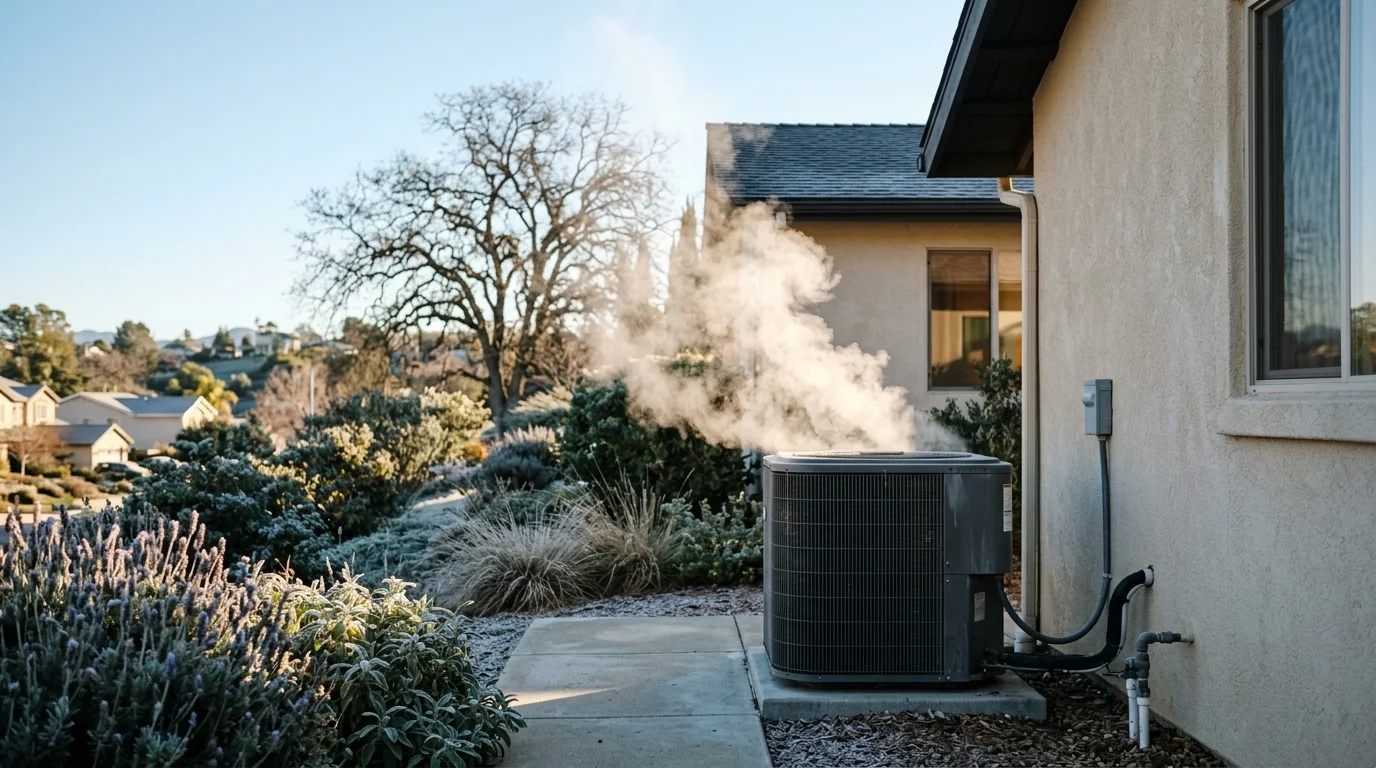
What homeowners may see around the outdoor unit
San Diego County is several climates sharing one name. Inland valleys and the backcountry, Alpine, Ramona, Escondido, Lakeside, and El Cajon, drop into the 40s on many winter nights, and sometimes the 30s. The outdoor coil can collect frost while it pulls heat from that air. When the unit reverses to melt the frost, ice turns to water on a still-cold coil. The water hits cold metal and cold air and flashes into a visible cloud. From the patio it reads as steam coming from the outdoor heat pump.
Coastal pads see a different version of the same picture. Pacific Beach, La Jolla, Encinitas, Imperial Beach, and National City sit in marine layer moisture. Air in the 40s and 50s can still hold enough water that a short burst of vapor hangs in the yard. The coil may carry less ice than a Ramona unit, and the cloud can still look thick in low sun.
The plume is usually white or light gray. It may hug the cabinet, then lift and thin. Water can drip from the base onto the pad or into the gravel. A light frost pattern on the fins can vanish as the cloud fades. Mini-split condensers on a Carlsbad side yard and larger central units on an East County pad both do this. Side-discharge cabinets push the cloud sideways. Top-discharge cabinets send it up.
A heat pump can produce a steam-like cloud because it is moving heat and melting ice. It is still a refrigeration machine. It does not boil water in radiators the way an old steam boiler does. Search results for this query are full of boiler threads from other climates. Those pages describe a different machine.
The timing is a clue you can write down later. The cloud often shows up on the first heat call after a cold night. It can return after a long run. Indoor rooms may stay on their set point while the outdoor unit works through that cycle. Licensed techs often describe that pattern as defrost vapor. That sentence is a description of a common operating event. It is not a remote diagnosis of your cabinet, your charge, or your board.
Flames, sparks, a dark column that keeps pouring after the fan stops, or an oily mist on the pad sit outside that picture. Those belong in the next checks, and they belong with a licensed HVAC contractor in person.
How to distinguish vapor from an unknown odor or smoke
Color, smell, and how long the cloud lasts are the three things you can observe from the walkway. Stay back from the fan and the electrical disconnect. You are collecting notes, not opening panels.
Water vapor is pale. In morning backlight along Highway 8 or in a Mission Hills side yard it can look denser than it is. It has little odor, or a faint wet-metal smell, like a cold coil and damp fins. It thins in open air. A breeze off the coast, or a sun hit on an El Cajon east wall, usually clears it once the frost is gone. People search heat pump smoking in cold weather because a phone photo of that cloud looks like smoke. The file on your camera is a poor judge. Your nose and the color in real light are better.
Smoke and electrical haze read darker. Gray-black, brown, or a sooty film on the grille is a different event. An acrid smell, hot plastic, burning dust that does not fade, a sharp electrical odor, or an oily smell next to the cabinet are reasons to treat the plume as unknown, not as morning steam. Do not lean into the discharge to confirm it. From a few steps back, note the color, the smell, and whether the cloud is still building after the outdoor fan has been still.
A heat pump that also shares a home with a gas furnace, a common hybrid setup in older Clairemont and College Area houses, adds one more smell to watch. A rotten-egg or raw-gas odor is a fuel-gas problem, not coil vapor. Leave the area. Use 911 and SDG&E’s published gas emergency path if you believe there is a leak. Do not assign that smell to the heat pump cloud.
Musty air at the indoor vents is a separate complaint, usually after a long cooling stretch. It does not explain a white outdoor plume at dawn. Burning dust on the first heat call of the season can have a short, dry smell as the indoor coil warms. That smell should fade. A plastic or wiring smell that grows is in the stop-and-inspect group below.
If the visual or the odor leaves you unsure, skip the guess. Emergency heat pump service is how you reach a licensed contractor who can look at the cabinet, the disconnect, and the indoor air together. Heat Pro SD matches you with that independent pro. We do not stand in the yard and we do not open the unit.
Why operating sounds may change during the event
Defrost is a mode change. The outdoor unit is briefly melting ice instead of collecting heat. The outdoor fan may slow or stop while the compressor keeps working. You may hear a click or a brief whoosh as the reversing valve shifts. A hiss at the lineset is common while refrigerant direction changes. Then the fan returns and the cloud starts to thin.
Indoor air can feel less warm for a short stretch during that mode. The system is using heat to clear the outdoor coil. Heating at the registers should come back after the cycle. That dip is one reason a Ramona ranch house can feel a little cooler at 6 a.m. even while the outdoor unit is busy. Heat pumps still heat on cold San Diego nights. The outdoor unit has to keep the coil clear to do that work.
Ice dropping off the fins can thud on the pad. A light rattle of water in the base is ordinary during melt. Those sounds sit in the same window as the vapor.
Sounds that sit outside that window are worth naming for a pro. Repeated hard bangs, a grinding bearing, metal-on-metal, a scream that rises with the fan, or a chatter that never settles after the valve click. Those are heat pump repair questions, not weather theater. Write down whether the noise started with the cloud or was already there last week. A unit that has been scraping for days and then steams at dawn has two stories, and the licensed tech needs both.
A short, single click at the start of a cycle is different from a breaker snapping off. If the outdoor unit dies mid-cloud and the house starts to cool, record the time. Error codes on a thermostat, if you have them, matter more than the look of the vapor.
What to check from a safe distance
Stand on the walkway or the driveway. Leave the fan guard, the electrical cover, and the disconnect handle alone unless a licensed contractor or the owner’s manual has already told you how to use that labeled switch. Pouring hot water on a frozen coil is a common backyard idea. It can crack a coil or put water into electrical parts. Skip it.
Look at the thermostat first. Confirm it is in heat, not emergency heat you did not mean to select, and that the set point is above room temperature. Then walk to a supply register. If warm air returns after the outdoor cloud fades, write that down. If the house is falling and the outdoor unit is still blowing a dark plume, that pairing is more urgent than a pale cloud on a 42-degree Alpine morning.
From the pad, compare ice to frost to a clear coil. A thin white film that is shrinking as vapor rises fits the melt story. A block of ice that never recedes, a coil buried in leaves from a Fallbrook oak, or a drain path frozen into a dam are details a tech can use. Standing water on the pad after a long drip is common during defrost. Water inside the house is not.
Glance at the breaker panel door only to see whether a heat pump breaker has tripped. Do not reset a breaker that keeps tripping. That is a licensed-electrical and licensed-HVAC problem, and California treats contracting work over the current threshold as licensed work. Confirm the current rule with the contractor and, for the license itself, use the CSLB license check.
Take two photos from where you already stand, one of the cloud and one of the coil after it thins. Note the city. A cloud at 7 a.m. in Ocean Beach in wet marine air is a different weather file than the same hour in Julian-adjacent cold. Time, place, and whether this happens every cold morning or only once will save the pro a lot of guessing.
Signs that justify shutting the system down
No California statute in our verified file lists a defrost shutoff rule. Treat the next signs as stop-and-inspect cues that licensed techs take seriously, and confirm the exact steps in your owner’s manual.
Shut the system off at the thermostat when you see dark smoke, sparks, a glow at the cabinet, an oily spray, or you smell burning plastic or wiring. If the manual points you to the outdoor disconnect, that is the labeled switch near the unit. Do not force a stuck handle. If you are unsure, leave the disconnect and wait for the licensed contractor.
Ice that never clears, with cold air at the registers, is another stop. The outdoor unit may still be trying to run. The house is not getting heat. A breaker that trips when the outdoor unit starts belongs in the same group. Water on an indoor ceiling or around the air handler is a shutoff cue even if the outdoor cloud looks pale.
A pale cloud that comes and goes on cold mornings, with heat returning indoors, is the pattern many homeowners watch for a day and then mention at the next service visit. A dark plume, a growing electrical smell, or a dead indoor supply is the pattern that belongs on an emergency heat pump repair call path. Heat Pro SD publishes no arrival time and does no field work. The independent licensed pro who shows up is the person who decides what is safe to run.
Gas odor, as above, is a fuel emergency. Use 911 and SDG&E. Do not keep sampling the air at the heat pump to decide.
What details help a repair pro assess the problem
A licensed HVAC contractor cannot see last night from the driveway. Your notes are the missing half of the visit. Write the time the cloud started and whether it faded. Name the city and the microclimate in one line: inland freeze in Ramona, marine layer in Point Loma, canyon shade in La Mesa. Say whether the plume was white, gray, or dark. Say whether you smelled water, plastic, oil, or nothing.
Add the sounds in order. Click, hiss, fan stop, thud of ice, then heat back at the register is one sequence. Grind, snap, silence is another. Indoor temperature at the thermostat, the mode, and any code on the display belong on that same card. If the unit sat through a power outage, say so. If someone recently cleaned the outdoor coil, or the last service date is on a sticker, say that too.
Photos from a safe distance help. A video that catches the fan stopping during the cloud is better than a still of white air. Do not send a close-up of live terminals. Age of the system, if you know it from a permit or a prior invoice, is useful. A guessed lifespan is not. We do not publish equipment life figures here.
Ask the visiting contractor for a CSLB license number and check it on the state lookup before work starts. Heat Pro SD connects homeowners in San Diego County with licensed independent heat pump pros. We hold no contractor license for the trade, we pull no permit, and we do not repair the cabinet. The person on the pad does that work and stands behind it.
If the visit turns into a repair, keep the same notes. Short cycling after the cloud, a coil that ices again within an hour, or heat that never returns are the details that separate a weather event from a machine that needs parts.
When to call us
A licensed Heat Pump Installation or repair contractor should see the outdoor unit in person when the cloud looks like smoke, the house is losing heat, or the sounds are new and harsh. Heat Pro SD matches you with that independent local pro and does no physical work. Call us at (858) 400-4374 and we’ll connect you with a licensed local HVAC contractor.