The first cool night after a long San Diego cooling season is when this shows up. The heat pump cooled the house through July and August without drama. You switch the thermostat to heat, the fan starts, and the rooms stay cool.
That split is the whole point of this page. Cooling still works. Heating does not. That is different from a unit that only struggles on a cold inland night. It is also different from a thermostat that fails in both modes.
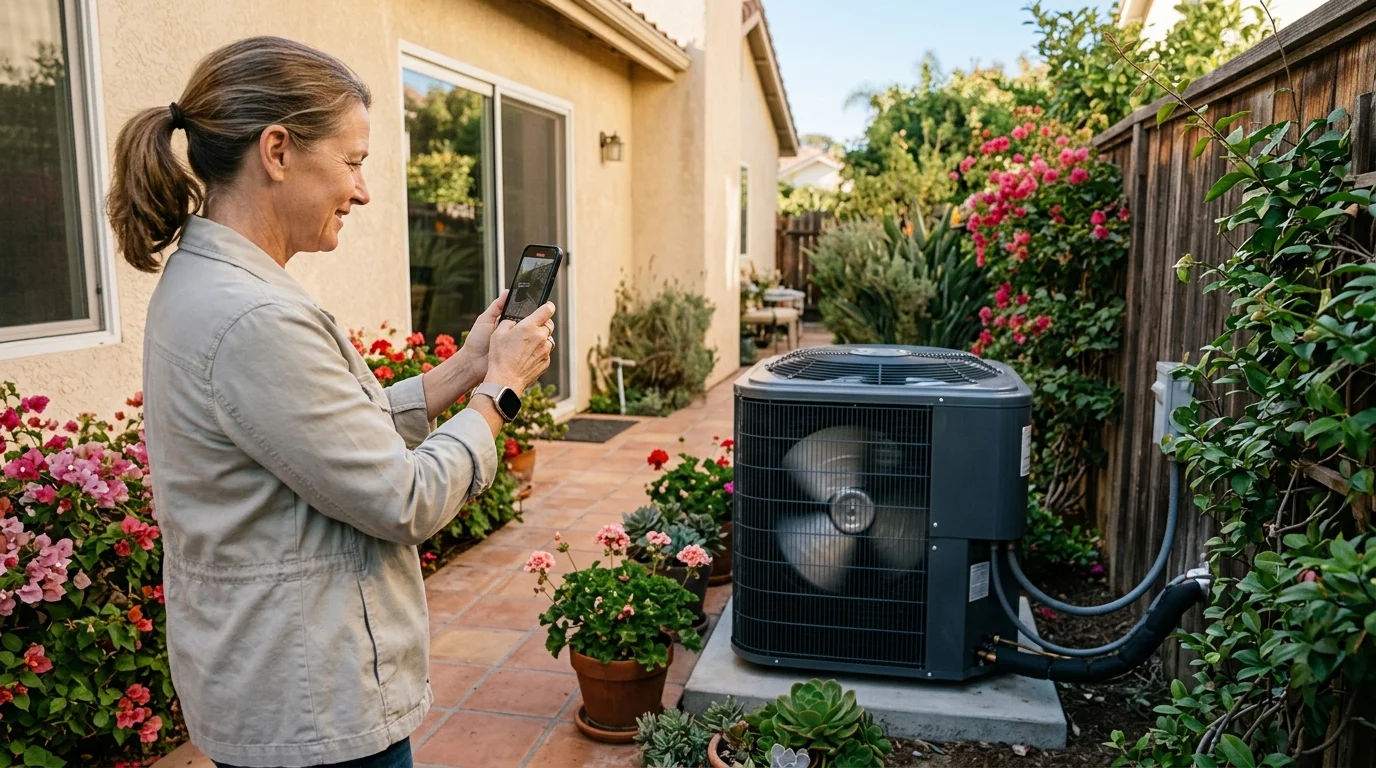
How to confirm cooling still operates
Before anyone names a heating part, confirm that cooling is still there. That single fact is what makes this a heat-mode problem, not a dead system.
Set the thermostat back to Cool. Put the setpoint a few degrees below the room reading. Set the fan to Auto. Let it run a full cycle so the outdoor unit has time to start. On a warm Carlsbad or Chula Vista afternoon, that is easy. After sunset in Alpine or Ramona, the house may already be too cool to ask for air conditioning. If that is the case, skip the cool test. Write “cooling not retested, last known good in [month].”
Watch three things. Does the outdoor unit run. Do the vents deliver air that feels cooler than the room. Does the system stop once it hits the setpoint.
If cooling still works, write it down. A licensed technician will use that. A heat pump that still cools has power at the indoor and outdoor equipment. The compressor can run. Air can move through the ducts or the indoor head. The open question is the heating path.
If cooling also fails, stop treating this as heat-only. The problem is broader than a mode that will not switch.
Do not keep flipping Heat and Cool as a stress test. One cooling confirmation and one heating test is enough. Extra mode changes do not prove a reversing fault from the living room. They just run the machine.
San Diego County is not one climate. Coastal north county homes in Encinitas, Solana Beach, and Oceanside often go April through November without a heat call. East County and the backcountry, El Cajon, Lakeside, Alpine, Ramona, ask for heat earlier. Sometimes that is October, while Mission Beach still sleeps with a window cracked. The longer the cooling-only stretch, the more that cooling confirmation is worth. It proves the equipment ran a full season in one direction.
If you have a dual-fuel system, a heat pump plus a furnace, cooling confirmation still matters. Cooling uses the heat pump. Heating may be trying a different path. Note which equipment you have. Do not assume the furnace should have taken over on a mild La Mesa night.
A heat pump that works in cooling but not heating is a useful report. It is not a diagnosis. Leave the cause to a licensed inspection.
Which thermostat settings deserve review
A lot of first-heat calls never leave the hallway. After eight months of Cool, Heat sits one tap away on a small screen. Wrong settings can look exactly like a heat pump not switching to heat.
Start with mode. It needs to read Heat, not Cool, Off, or a vacation hold. Then look at the setpoint. It has to sit above the temperature the thermostat is displaying. If the room reads 68 and the set point is 68, many systems will not start.
Set the fan to Auto, not On. Fan On runs the blower even when the heat pump is not heating. That is a common reason the fan is running but you are not getting any heat. You feel room air at the register. The outdoor unit may be sitting still.
On a smart thermostat, open the schedule and any geofence or vacation setting. A hold from last winter, or a “home/away” rule, can flip mode overnight. In a downtown or UTC condo, the thermostat may also be locked by an HOA. If you cannot change mode, write that down. The next person needs to know.
Some thermostats have an equipment type buried in installer settings, heat pump versus furnace. If that type is wrong, Cool can still work while Heat calls the wrong thing. Do not guess your way through installer menus. Note the brand and model on the thermostat. Compare what you see with thermostat problems that look like heat pump problems. Then stop.
If the screen is dim or blank, replace the batteries if the thermostat uses them. A dead display is a control issue, not a coil issue.
If you see Emergency heat, Aux, or EH, note it. Do not use that setting as a home experiment. It is not a proof test, and it is not a diagnosis. On dual-fuel systems, also note whether the thermostat is calling for the heat pump, the furnace, or both.
One more San Diego wrinkle. In a Clairemont or Kearny Mesa house with the thermostat in a sunny hallway, the display can read warmer than the bedrooms. The system thinks it is done. Walk the house. Compare the thermostat reading with how the rooms actually feel. If they disagree by a lot, say so. Do not call that a failed heat pump on the spot.
If cooling ran correctly on this same thermostat a few minutes ago, a totally dead thermostat is less likely. A wrong heat setting is still likely. Fix the settings you can see. Leave hidden configuration to a licensed pro.
What airflow observations can reveal
Heating and cooling share the same filter, the same returns, and often the same ducts. Weak airflow can make heat feel like it never arrived, even when the outdoor unit is running.
Pull the filter and look at it in the light. If you cannot see light through it, it is dirty. Follow the manufacturer’s replacement interval for the filter you actually use. A clogged filter can cut supply air to a whisper. In a Petco-adjacent South Park bungalow with two dogs, that can happen faster than in a low-occupancy condo.
Walk the house and check returns and registers. Closed bedroom doors, blocked returns behind sofas, and taped-off vents in unused rooms all starve a ducted system. In many Chula Vista and National City homes the air handler sits in a tight garage closet. Boxes stacked around it do the same damage as a dirty filter. In older Clairemont and Serra Mesa houses the air handler is often in the attic. You do not need to climb up there. Just note weak rooms versus strong ones.
Then look at the outdoor unit, from the ground, with the system off if you already decided to stop. Coastal north county side yards collect salt film, palm litter, and ice plant. Inland yards in Escondido, Santee, and El Cajon collect dust, eucalyptus leaves, and grass clippings. Bougainvillea against the coil is a classic North County sight. Clear loose debris from around the unit. Do not drive a screwdriver or a hose jet into the fins.
Light frost on a cold Alpine or Ramona morning can be normal and then clear. A unit locked in ice is not something to chip. Leave ice in place, keep people and pets away from the fan, and treat that as a stop condition in the next section.
Air that feels milder than old furnace air is not, by itself, a failure. Heat pumps move heat. They do not blast the way a gas furnace does. The real airflow tell is volume. If almost nothing comes out of the vents, or one wing of the house is dead while another is moving air, write that down. If airflow was already weak in cooling, this is not a heat-only story.
Do not turn those notes into a refrigerant, duct-leak, or coil diagnosis. Observation is the job at home. Cause is the job on a licensed visit.
What to record during the first heating test
Run one heating test, on purpose, and write what happens. That log is more useful than a second or third guess.
Put the thermostat in Heat. Set it a few degrees above the room reading. Fan on Auto. Let it run long enough for the outdoor unit to start and for the indoor blower to settle. Then record:
- Date, time, and city or ZIP
- Outdoor condition in plain words (marine layer in Ocean Beach, clear and cool in Ramona, windy Santa Ana night in Escondido)
- Thermostat mode, setpoint, fan setting, and the temperature it displays
- Whether you can hear or see the outdoor fan and whether the outdoor unit sounds like it is working
- What the supply air feels like against your hand: cooler than the room, about the same, or warmer
- Whether the indoor temperature actually rose after a full cycle
- Filter condition and any blocked vents you already found
- Ice, heavy frost, steam, or debris at the outdoor unit
- Which rooms changed and which did not
- Whether you confirmed cooling earlier
That list answers the questions people actually type. Why is the heat pump blowing cold air in heat mode. Why is the fan running with no heat. Why is it on, but not blowing hot air. The answers live in those notes, not in a named failed part.
Place matters inside the county. On a 45-degree night in Julian or the San Diego backcountry, brief cool air can be a defrost cycle, not a dead heating mode. If the house warms after that cycle, you are in a different problem. Read do heat pumps work on cold San Diego nights for that pattern. This page is for the other pattern: cooling still works, and heating never takes the house anywhere, even on a mild Encinitas or Pacific Beach evening in the 50s or 60s. Defrost is an unlikely story on a night that never drops near freezing.
If you own a simple thermometer, a supply reading and a return reading are helpful. If you do not, your hand plus the thermostat’s room temperature are enough. Do not chase a number you saw on a national repair page. Those figures are not verified here, and they vary by equipment.
One test. Notes in your phone. Then decide whether the system should stay off.
When the system should remain off
Stop using the heat pump, and leave it off, if any of these show up.
A breaker that trips, or trips again after one reset. Indoor and outdoor equipment often sit on separate breakers. If either will not stay on, do not keep flipping it.
A burning, hot-electrical, or sharp chemical smell at the indoor unit, the outdoor unit, or the thermostat.
Water at the indoor unit, a ceiling stain under an attic air handler, or standing water in a garage closet.
Ice you would have to break off the outdoor coil or the copper lines.
A loud grinding, screaming, or repeated hard clicking from the outdoor unit.
Any panel you would have to open, or any wire you would have to touch, to “just check.”
Those are not DIY repairs. Refrigerant work and electrical work belong to a licensed contractor. Unlicensed contracting is a misdemeanor under California Business and Professions Code 7028. Heat Pro SD does not perform that work. We match you with licensed independent pros.
If you already confirmed cooling, you do not need another cool cycle as a comfort trick while heat is broken. Space heaters on overloaded bathroom circuits are a poor substitute. Keep clearances around any backup heat you already own, and treat the heat pump as off until a licensed tech says otherwise.
A system that cools but will not heat can wait for a scheduled heat pump repair visit when none of the stop signs above are present. When a stop sign is present, leave it off. Do not run more heating tests.
What a professional inspection should test
A licensed HVAC contractor should treat “cools, will not heat” as a mode problem until the measurements say otherwise. The visit is a test plan, not a guess from the vents.
Ask the pro to confirm the thermostat’s heat call actually arrives at the equipment. Wrong wiring, a wrong equipment type, or a failed thermostat can look like a dead heating mode. Cooling can still look fine.
Ask them to watch what the outdoor unit does when that heat call lands. A heat pump has to reverse to heat. A homeowner cannot confirm a reversing valve, a stuck solenoid, or a control board from the register. Those are licensed checks with the right tools. Do not let anyone name the part from a phone photo of your vents.
Ask for an airflow and filter check, indoor coil condition, and outdoor coil condition. Salt on a La Jolla or Imperial Beach unit is not the same mess as inland dust in Poway. Both can strangle heat more than you felt in cooling, because heating asks the outdoor coil to collect heat, not reject it.
If they check refrigerant, that is a measured test after leak checks, not a refill on suspicion. Low charge is a possible finding. It is not something you can declare from lukewarm air. The same is true of capacitors, contactors, defrost sensors, and backup heat. Possible. Not proven from the couch.
On dual-fuel homes, the inspection should include the changeover. The heat pump may be fine. The thermostat may be waiting on a furnace that is not set up, or the furnace path may be the one that failed.
Bring the notes from your heating test. They save time. A focused heat pump inspection is the right next step when the system still cools and none of the shut-off signs are present.
Before anyone starts work, look up the contractor on the CSLB license check. Use that site, not a third-party badge. Heat Pro SD matches homeowners with licensed independent local pros and performs no physical work.
When to call us
If your heat pump still cools and will not heat, or you hit a shut-off sign in the list above, it is time for a licensed HVAC contractor, not more mode flipping. Call us at (858) 400-4374 and we’ll connect you with a licensed local HVAC contractor.