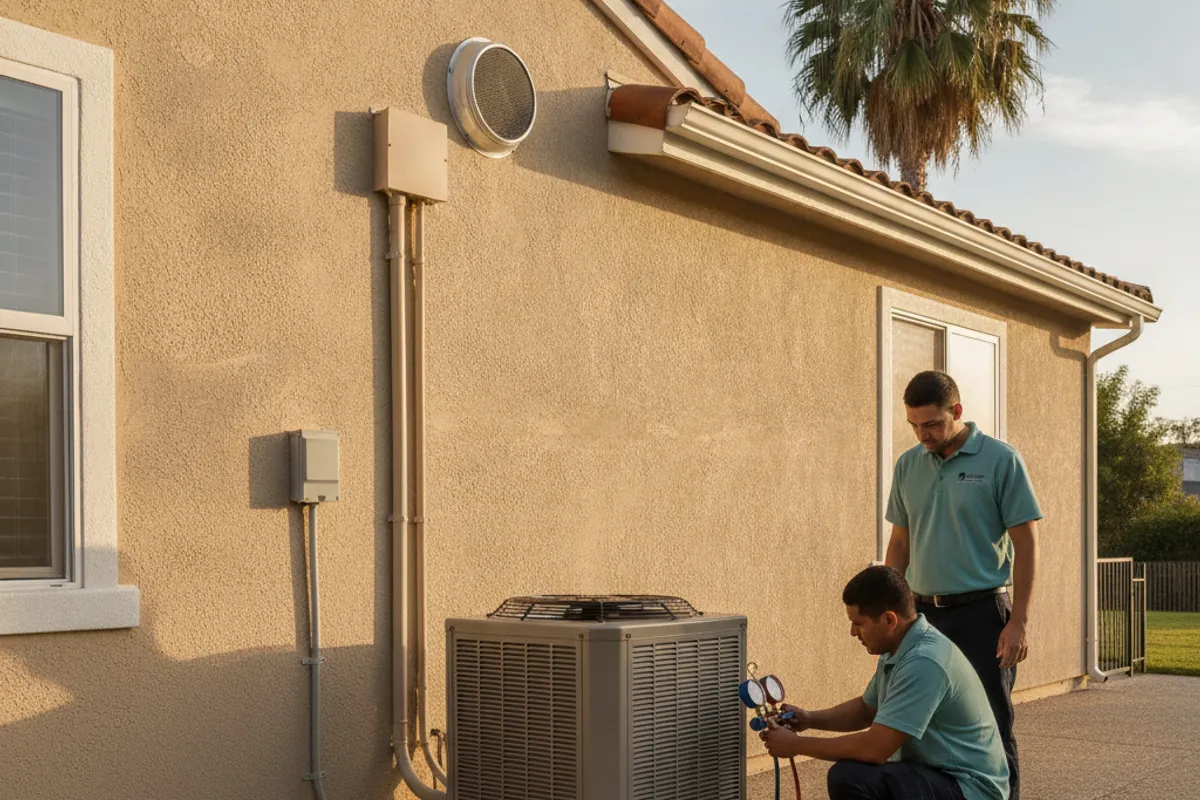
A standard air conditioner moves heat out of your home and only cools. A heat pump uses nearly the same refrigeration process, then reverses it to move heat indoors for heating. That’s the plain-English answer to the heat pump vs air conditioner question.
The outdoor units can look almost identical. Both contain a compressor, coil, and fan. The difference is what happens when the thermostat calls for heat. A standard AC can’t reverse direction. A heat pump can.
Heat pump vs air conditioner: the core difference
Both systems move heat through a closed refrigeration circuit. They don’t create cold air. Instead, refrigerant absorbs heat in one location and releases it somewhere else.
The equipment’s direction determines whether the house gets cooler or warmer.
How a standard air conditioner works
A standard central AC has an indoor coil and an outdoor condenser. Refrigerant travels between them while the blower moves indoor air across the coil.
During cooling, the indoor coil absorbs heat from the house. The refrigerant carries that heat outside. The outdoor coil then releases it into the air.
That process continues until the thermostat reaches its cooling setting. The system then shuts off or reduces its output, depending on its controls.
A cooling-only AC repeats this process in one direction. It has no heating mode. A home using central AC therefore needs separate equipment if it also needs heat.
That separate equipment could be a furnace, wall heater, or another heating system. Our gas furnace and AC comparison explains that broader equipment decision.
How a heat pump works
A heat pump uses the same basic cooling cycle. In summer, it moves indoor heat outside like a standard air conditioner.
Its defining component is the reversing valve. This valve changes the direction of refrigerant flow when the thermostat calls for heat.
The outdoor coil then absorbs heat from the outside air. Refrigerant carries that heat indoors, where the indoor coil releases it. The blower distributes the warmed air through the home.
Outdoor air still contains usable heat during cool weather. A heat pump transfers that heat instead of producing all its heat directly. Some systems can also include supplemental heating equipment, depending on the home and selected design.
That makes the one-line explanation accurate: a heat pump is essentially an air conditioner that can also heat.
| Feature | Standard air conditioner | Heat pump |
|---|---|---|
| Summer operation | Moves indoor heat outside | Moves indoor heat outside |
| Winter operation | No heating mode | Reverses and moves heat indoors |
| Refrigerant direction | Cooling direction only | Changes between cooling and heating |
| Defining control | Cooling controls | Reversing valve and heating controls |
| Separate heat needed | Yes, when the home needs heating | Not necessarily |
| Main purpose | Cooling | Heating and cooling |
The two systems can provide similar cooling functions. The meaningful difference appears during colder months.
Comparing installed cost and retrofit work
There isn’t one San Diego price difference that applies to every home. Equipment selection is only one part of an installed quote.
A cooling-only AC quote may include an outdoor condenser and matching indoor coil. A heat pump quote must also account for compatible heating controls. The indoor equipment, thermostat, electrical circuit, refrigerant lines, and ductwork can affect either project.
A useful heat pump vs air conditioner quote comparison should place the systems on equal terms. Ask each professional to identify:
- The outdoor and indoor equipment included
- The cooling capacity and efficiency ratings
- Whether the thermostat must change
- Whether existing refrigerant lines can stay
- Whether the electrical circuit or panel needs work
- Whether the existing ducts fit the proposed system
- Which parts of the project aren’t included
The heat pump’s additional heating function can change the equipment and control scope. However, an AC-only bid doesn’t include the value or cost of separate heating equipment. Comparing outdoor-unit prices alone misses that distinction.
This matters in an older beach-area bungalow with a wall heater or no central heating system. Adding another standard AC preserves that arrangement. Choosing a heat pump adds central heating capability through the same refrigeration system.
A professional still needs to inspect the indoor equipment and electrical setup. An existing AC condenser doesn’t prove every connected component will support heating mode.
Read the AC-to-heat-pump replacement guide for a closer look at those components. The San Diego heat pump cost guide covers the questions to bring to local quotes.
Heat Pro SD doesn’t set project prices. Customers contract with and pay the independent professional directly.
Efficiency and operating costs in San Diego
A heat pump’s heating performance changes with outdoor conditions. Moving heat during mild weather generally requires less work than collecting it during severe cold.
That distinction favors a location-specific comparison. Coastal San Diego and the inland valleys don’t place identical demands on HVAC equipment.
A home near Pacific Beach or Encinitas may have light winter heating needs and regular marine influence. In that setting, the heat pump’s heating mode usually works under milder conditions than equipment serving a cold-climate market.
El Cajon, Ramona, and the county’s backcountry communities face a wider seasonal range. Cooling capacity can carry more weight inland. Winter equipment selection also deserves closer attention as locations gain elevation or experience colder nights.
That doesn’t make a heat pump unsuitable inland. It means the professional should size and select it for the actual property. A coastal assumption shouldn’t be copied onto a backcountry home.
Electricity price also belongs in the operating-cost comparison. Use the current rate information on your SDG&E bill or published rate plan. Generic national averages won’t reflect a specific San Diego household.
If an AC is paired with gas heating, compare both energy sources. Looking only at summer electricity leaves out winter fuel use. A heat pump places both cooling and most or all space heating on the electric bill.
Equipment efficiency is only part of the result. Home size, insulation, thermostat settings, duct condition, and coastal or inland location all affect usage. No responsible comparison should promise a particular bill reduction without examining the home and its records.
Which system fits the actual home?
Start with what the home needs, not the equipment label.
A standard air conditioner may fit when the goal is cooling only. That can make sense when a homeowner plans to keep separate heating equipment and doesn’t want the cooling replacement to change that arrangement.
A heat pump fits a different brief. It provides cooling while adding a reversible heating mode. That’s especially relevant when an aging AC needs replacement and the owner also wants another heating option.
Use this short framework:
- Choose based on cooling alone: Compare AC equipment with similar cooling capacity and efficiency.
- Choose based on year-round function: Include the value and scope of the heat pump’s heating mode.
- Check the existing system: Identify the indoor coil, air handler, thermostat, circuit, and ducts.
- Account for location: Separate coastal conditions from inland and backcountry demands.
- Compare complete quotes: Make sure both proposals list included equipment and home modifications.
Homes without usable ducts need another decision. A ductless system can deliver heating and cooling without adding a central duct network. See the ductless versus central heat pump guide for that comparison.
Homes with existing ducts can start with the central heat pump installation overview. San Diego homeowners can also review the local heat pump service area page.
Frequently asked questions
Is a heat pump also an air conditioner?
Yes. In cooling mode, a heat pump performs the same basic job as a standard air conditioner. It absorbs heat indoors and releases it outside.
The difference appears in winter. A reversing valve lets the heat pump change refrigerant direction and provide heating.
Does a standard air conditioner provide heat?
No. A standard cooling-only air conditioner moves heat outside. It needs separate heating equipment when the home requires heat.
Check the thermostat and equipment model if the system type is unclear. Similar-looking outdoor cabinets can contain either type of equipment.
Can a heat pump cool as well as an air conditioner?
Both systems use a refrigeration cycle to remove indoor heat. Actual comfort depends on equipment selection, sizing, airflow, duct condition, and installation.
Compare proposed cooling capacity and efficiency on equal terms. Don’t assume the heating feature determines cooling performance.
Do heat pumps work during San Diego winters?
Heat pumps can provide heating by collecting outdoor heat and moving it indoors. San Diego’s coastal areas generally present milder heating conditions than cold-climate markets.
Inland, elevated, and backcountry properties need their own equipment assessment. The professional should match the system to the home’s location and heating demand.
Which option costs more to install?
There’s no fixed difference for every home. The answer depends on matched indoor equipment, controls, electrical work, refrigerant lines, ducts, and the selected system.
Ask for itemized, like-for-like proposals. Heat Pro SD doesn’t establish contractor pricing.
Can I replace my AC with a heat pump and keep the ducts?
Existing ducts may remain when their size, condition, and airflow suit the proposed equipment. That decision requires an on-site assessment.
The indoor coil, air handler, thermostat, circuit, and refrigerant lines also need review. Replacing the outdoor cabinet alone may not complete the conversion.
Heat Pro SD connects customers with licensed, independent local heat pump professionals across San Diego County’s 67 service-area cities. For help comparing equipment for your home, call (858) 400-4374. The line plays a recording notice, then accepts a recorded and transcribed message.