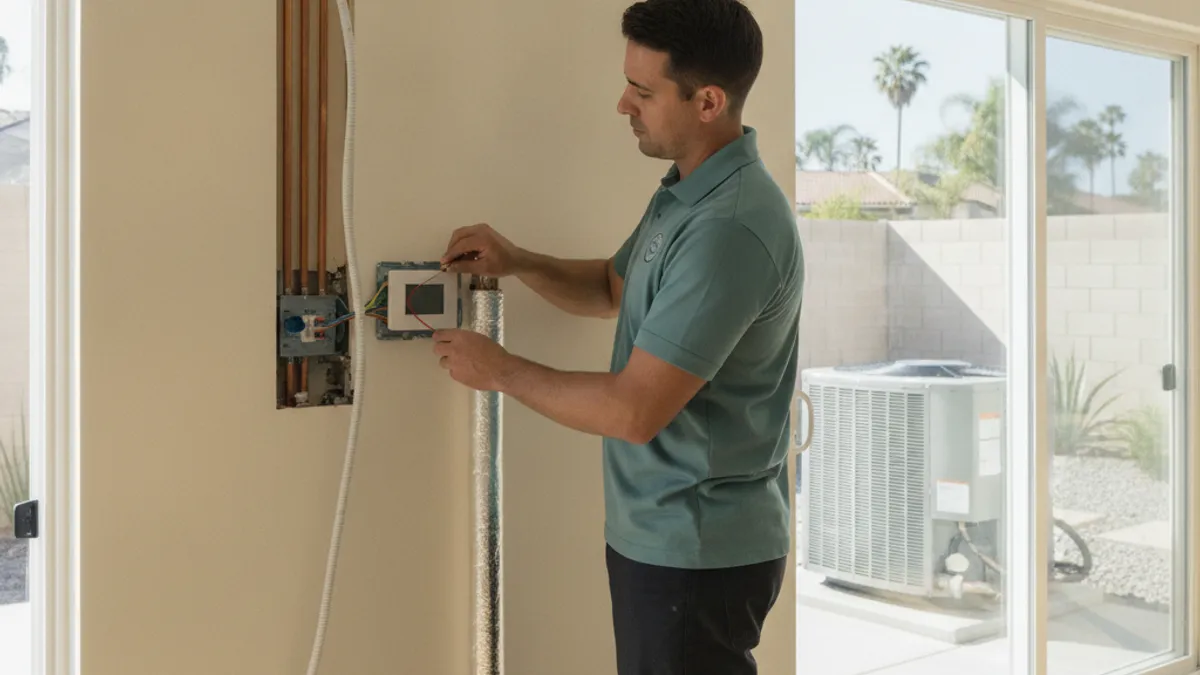
Why this is not a generic thermostat swap
A heat pump needs a control that can run heating and cooling from the same outdoor unit. Many systems also use a reversing-valve terminal, labeled O or B depending on the equipment, and some have auxiliary or emergency heat. A thermostat that only knows furnace heat or cooling-only AC can fit the wall and still be wrong.
Heat Pro SD does not install thermostats and does not publish an installed price. We match homeowners with licensed independent HVAC pros.
What actually drives the quote
There is no honest San Diego average for this job. The written scope should separate:
- The thermostat model, with a compatibility statement for your indoor and outdoor equipment
- Any adapter the manufacturer lists for that model
- Control-wire work, including a C-wire or an approved alternative
- Configuration of reversing valve and auxiliary heat
- Testing in heating and cooling
- Wall repair if the new plate does not cover the old footprint
Older plaster walls, finished attics, and multi-zone systems change access. Those are inspection items, not a published adder.
Compatibility before you buy the hardware
Photograph the existing terminal labels before anything is moved. Photograph the indoor and outdoor model numbers. Then check the thermostat manufacturer’s current compatibility guide for that configuration.
Ask the contractor to confirm:
- Equipment type (heat pump, not furnace-only)
- Stages of heating and cooling
- Whether auxiliary or emergency heat exists
- Whether the system is zoned or uses a manufacturer controller that a generic wall stat cannot replace
Mini-split indoor heads often use the manufacturer’s wall controller, not a common 24-volt furnace thermostat. Do not assume a retail smart thermostat drops onto every ductless head.
O/B and the reversing valve
The O/B terminal tells the outdoor unit which way the reversing valve should sit. Wired or configured backward, the system can heat when you asked for cooling, or the reverse. That can look like a failed heat pump.
Do not guess from wire color. The equipment documentation and the existing terminal labels decide the assignment. If labels are missing, stop and let a licensed HVAC contractor trace the controls. Miswiring is not a recommended DIY experiment.
The C-wire, documented at both ends
Many electronic thermostats need a common (C) conductor or a manufacturer-approved adapter. A spare wire in the wall may be unused or landed on a different terminal at the air handler.
Ask the installer to confirm both ends of each conductor and to photograph the finished landing. If an adapter is used, keep its instructions with the heat pump paperwork. An adapter is part of the quoted scope, not a surprise at the truck.
Multi-zone systems
A house with several thermostats or several mini-split heads is several control points. Some systems support a central interface. Others do not. Compatibility is model-specific. Ask before you buy a stack of identical retail stats.
DIY limits
Low-voltage thermostat work is still easy to get wrong. If you do any owner steps, follow only the thermostat and HVAC manufacturers’ instructions for that model. Do not move conductors from a generic color chart. If the O/B assignment, auxiliary heat, unlabeled wires, or a missing C-wire is unclear, hire the licensed pro.
California contractor licensing still applies when the work is contracting. Use the CSLB license check.
Smart features versus bill claims
A smart thermostat can help you see mode, auxiliary-heat calls, and schedules. It does not, by itself, prove a lower SDG&E bill. Time-of-use plans and pre-cooling are account-specific. Read your current SDG&E plan. Do not treat app marketing as operating-cost proof.
If you want help matching controls to a heat pump, see thermostat and controls.
Heat Pro SD matches homeowners with licensed independent HVAC pros and performs no physical work. The Heat Pro SD line is voicemail with a recording-consent notice. Leave a message at (858) 400-4374.
Can any smart thermostat control a heat pump?
No. Confirm heat-pump compatibility, reversing-valve support, and any auxiliary heat in the manufacturer’s guide for your equipment.
Do I need a C-wire for a heat pump thermostat?
Many smart thermostats need a C-wire or an approved adapter. Your existing cable may or may not include it. Confirm both ends before you buy.
How long does a thermostat replacement take?
Ask the contractor for a sequence that includes wiring and setup. This page does not publish a typical number of minutes.
Need a licensed independent pro to inspect wiring and quote a compatible control? Leave a voicemail at (858) 400-4374.