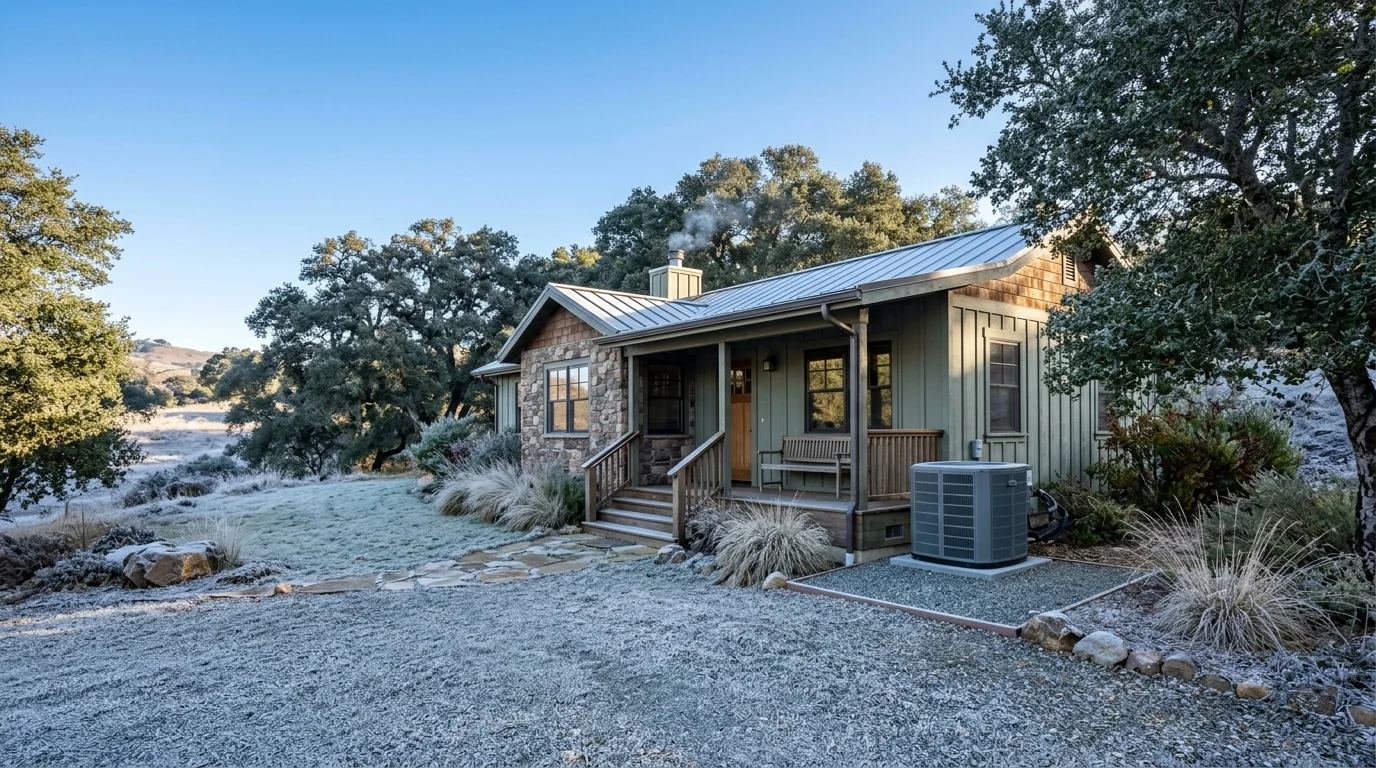
If you’re planning a heat pump for Ramona, Julian, or the San Diego backcountry, start with the property itself. The decision should account for winter design conditions, electrical service, ducts, propane use, and outage planning. A backcountry house shouldn’t be sized from coastal assumptions.
How much colder the backcountry actually gets
There isn’t one backcountry temperature that fits every project. Conditions used for system design should match the specific address. They shouldn’t come from a weather file chosen for convenience. This page does not add climate numbers.
That distinction matters across Ramona, Julian, Santa Ysabel, Warner Springs, Pine Valley, and Descanso. Even nearby properties can have different exposure, shade, construction, and elevation. A house near State Route 78 in Ramona shouldn’t automatically receive the same assumptions as a property near Highway 79 outside Julian.
Ask the contractor to show the outdoor design temperature used in the load calculation. The proposal should also name its weather-data source. If the calculation uses coastal San Diego conditions, ask why they apply to the property.
Then review the house itself. Note rooms with high ceilings, exposed walls, large windows, or weak insulation. Include converted garages, additions, enclosed porches, and rooms over crawlspaces. These spaces can affect the equipment and duct plan.
Avoid choosing a system from a general description like “inland San Diego.” That label covers too much ground. Our guide to coastal and inland heat pump differences explains why address-specific planning matters.
The goal isn’t to find the coldest possible assumption. It’s to use a documented condition that fits the house. A licensed HVAC contractor should be able to explain that choice in plain language.
What propane heating costs a rural household
Propane has no single posted rate the way utility gas does. Your supplier sets the delivered rate and any account-related charges. Confirm each current item directly before comparing heating options.
Start with your own propane records. Gather delivery invoices across a complete heating period. Separate space-heating use from cooking, water heating, fireplaces, pool equipment, or other propane appliances. If the tank serves several uses, ask the supplier how to read the delivery history accurately.
Next, request an itemized heat pump proposal. It should state the equipment being considered and the assumptions behind its estimated electricity use. Compare those assumptions with the current SDG&E rate information for your actual rate plan. Don’t rely on an undated utility price copied from a sales worksheet.
This comparison shouldn’t promise a fixed savings amount. Weather, thermostat settings, insulation, duct condition, equipment selection, and household routines all affect the result. Instead, ask the contractor to show the inputs so you can test them against your bills.
Treat incentives separately from operating costs. Program status can change during the year. Check the California Energy Commission and the IRS energy credit page on the day you review the proposal. Don’t accept an undated rebate or tax-credit figure.
A useful comparison is transparent and property-specific. It should show what was measured, what was assumed, and where each current rate came from.
Cold climate heat pumps and what changes in the spec
“Cold climate” on a product description isn’t enough by itself. Ask for the manufacturer’s published performance data for the exact indoor and outdoor equipment combination.
The contractor should identify the heating capacity at the outdoor design condition selected for your property. The submittal should also address power input, defrost operation, indoor airflow, and any supplemental heat included in the design. Ask how those details change as outdoor conditions change.
Don’t substitute a general efficiency label for cold-weather performance. Current efficiency standards should be confirmed through the U.S. Department of Energy rather than copied from an older article. The contractor should explain the proposed model without relying on a sales nickname.
Outdoor placement deserves a site review too. Ask the pro to document clearances, drainage, roof runoff, nearby vegetation, service access, and the proposed pad. A backcountry installation plan should reflect the exact spot beside the house, not a generic equipment diagram.
Controls also belong in the written scope. Ask when supplemental heat would operate, how defrost affects indoor comfort, and which thermostat settings the contractor recommends. Those answers should match the installed equipment combination.
For more context, read our guide to heat pumps on cold San Diego nights. Then ask the licensed pro to connect those principles to the measured conditions at your Ramona or Julian property.
Power outages, and planning for them
An outage plan should be discussed before equipment is selected. Start by listing the loads that matter during an interruption. That list might include the heat pump, indoor fan, controls, refrigerator, well pump, medical equipment, lighting, and communications.
Ask what parts of the proposed heating system become unavailable without utility power. If supplemental electric heat is included, have its electrical demand listed separately. Don’t assume that a backup source designed for household lights can also support heating equipment.
Existing batteries and generators need their own review. Give the HVAC contractor and qualified electrical professional the equipment documentation. Ask them to identify which loads the backup system can support and what switching equipment applies. Don’t rely on a plug size, marketing label, or informal test.
Our guide to battery backup for a San Diego heat pump covers questions to bring into that conversation. The final plan should be written for the actual equipment, panel, and backup source.
Also decide what acceptable outage operation means for your household. Some owners want limited heating in selected rooms. Others plan to use a separate existing heat source. The contractor should document the proposed sequence without making assumptions about your priorities.
Keep operating instructions with the equipment records. Everyone in the household should know which loads are supported and which aren’t. Any generator connection, transfer equipment, or panel work should be reviewed by the appropriately licensed professional.
Well pumps, panels and rural electrical service
A rural electrical review needs more than a glance at the panel label. Ask the contractor to inventory major loads that may run alongside the heat pump. Include a well pump, water heater, cooking equipment, vehicle charging, workshop tools, pool equipment, and supplemental heat when present.
Provide nameplate information and recent electrical records when available. The contractor should explain how the proposed HVAC equipment fits the property’s measured electrical conditions. If an electrical upgrade is recommended, request the load calculation and an itemized scope.
Don’t accept a vague statement that a panel replacement is automatically required. Don’t accept a proposal that ignores the panel, either. The recommendation should connect the selected equipment, existing loads, and service conditions.
Properties with long wire runs or detached equipment locations need extra documentation. Ask where the indoor unit, outdoor unit, disconnects, and controls would sit. The proposal should identify any trenching, access, or coordination that may affect the work.
For an address outside an incorporated city, ask the contractor to confirm the current permitting authority for that parcel. Confirm it with that city or county building department. The utility should confirm its own service requirements when utility-side work is proposed. Requirements shouldn’t be borrowed from another town or an older project.
Before signing, verify the contractor through the official CSLB license check. Heat Pro SD matches homeowners with licensed, independent local HVAC pros. The matched contractor performs the physical work and handles the project scope. Call (858) 400-4374 and leave a voicemail. The line plays a recording-consent notice.
Sizing for a house with real winter, not coastal winter
Good sizing starts with a documented, room-by-room load calculation. The contractor should measure the house rather than copy the capacity of the existing furnace.
Ask what the calculation includes. It should address insulation, windows, air leakage, ceiling height, orientation, additions, and the location of ducts. Rooms with different exposure or construction should be considered separately.
The contractor should also record the outdoor design condition used for your Ramona, Julian, or backcountry address. Ask where that condition came from. A coastal assumption shouldn’t appear without a clear reason.
Existing ducts need inspection before they become part of the new design. Ask about their size, condition, routing, insulation, and leakage. A proposal that keeps the ducts should explain why they suit the required airflow. A proposal that changes them should identify each modification.
Have the pro explain the effects of sizing above or below the calculated load. Discuss cycling, room comfort, supplemental heat, airflow, and electrical demand. These points should connect to the exact equipment combination in the proposal.
For a ducted project, review what’s included in central heat pump installation. Request model numbers, equipment matches, controls, duct work, electrical work, permit responsibility, startup checks, and warranty terms in writing. Confirm that warranty coverage comes from the contractor or manufacturer, not Heat Pro SD.
A backcountry quote should read like it was prepared for your house. If the same proposal could fit a coastal condo, ask for a more specific design.
When to call us
Call when your Ramona, Julian, or backcountry project needs cold-weather sizing, duct review, electrical coordination, or a clear comparison with existing propane use. Heat Pro SD matches you with a licensed independent local HVAC contractor and performs no physical work. Call us at (858) 400-4374 and leave a voicemail.