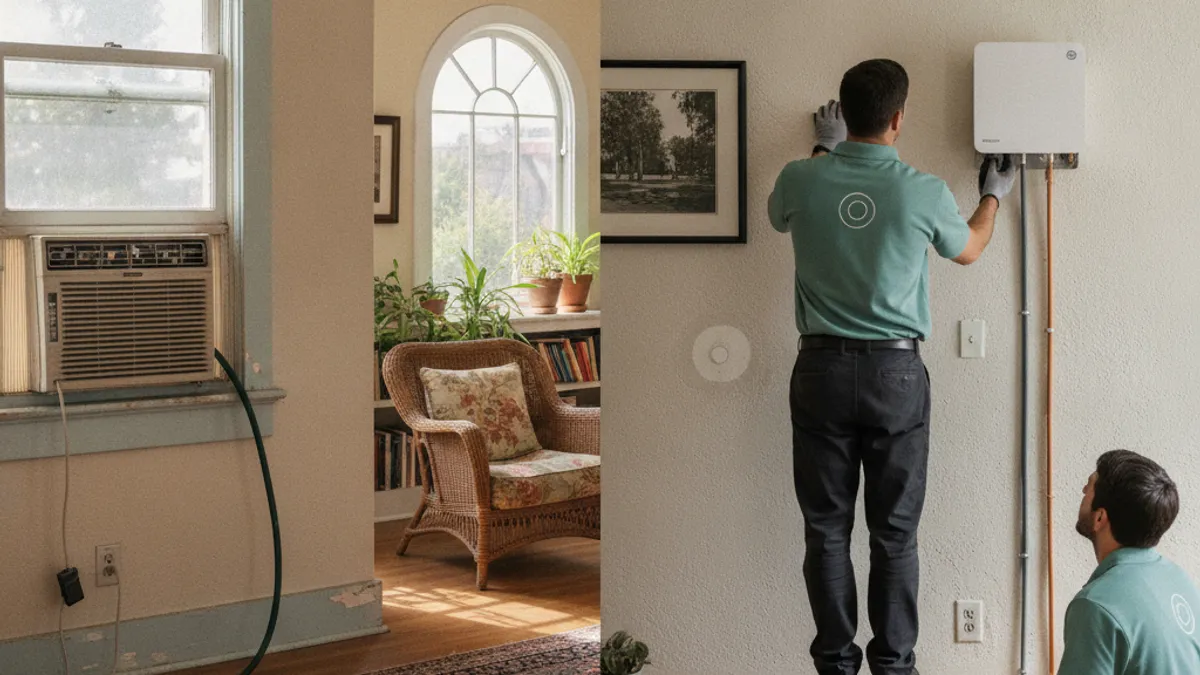
The decision an older house actually faces
If you own a house in South Park, Kensington, University Heights, or a similar pre-ductwork street, the useful comparison is often a window air conditioner versus a ductless mini-split for one or two rooms. It is not a “best window unit” product roundup. It is also not automatically a full central system, because many of these houses never had ducts.
Heat Pro SD does not install either option. We match homeowners with licensed independent HVAC pros for mini-split work. A window unit you buy and set in a sash is not a Heat Pro SD service.
What a window unit actually is
A window air conditioner is a packaged cooler that sits in an opening. It can be a short-term or rental-friendly way to cool one room when you cannot modify the wall.
Tradeoffs to put on paper:
- It occupies window area and can affect security and weatherstripping
- It cools. It does not heat like a heat-pump mini-split
- The compressor is at the window, so room noise is part of the product
- In an older single-pane opening, the fill panels around the chassis are a leak and moisture path unless they are installed as the unit’s instructions require
A renter should still read the lease. Some buildings ban window units or limit how they are braced.
What a ductless mini-split is
A single-zone mini-split uses an indoor head, usually high on a wall, a small refrigerant line set through the wall, and an outdoor unit. It heats and cools when the equipment is a heat pump, which most residential mini-splits are.
That is a construction project. It needs a location for the outdoor unit, a line-set route, condensate routing, and electrical service as specified. It does not require a full duct system. That is why it shows up in older San Diego houses.
See ductless mini-split installation and heat pumps for older San Diego homes.
When a window unit is still the honest choice
A window unit can be the right tool when:
- You rent and cannot get approval for a wall penetration or outdoor unit
- You need cooling for a short season and will remove the unit
- The room is used rarely
- You are not ready to take on a permitted mechanical job
Those are use and permission reasons, not a ranking of brands.
When a mini-split is the better long-term room solution
A mini-split is worth a licensed proposal when the room is used daily, such as a bedroom, office, or converted garage, and you want heating as well as cooling. It also matters when the current approach is to overcool the rest of the house to help one hot room.
It is not a payback formula. There is no published year when a mini-split “wins” on this page. Compare an itemized mini-split proposal with what you actually pay to run and replace window units, using your own bills and quotes.
Sound, without invented decibel bands
A window unit puts the compressor at the room. A mini-split’s compressor sits outdoors. Indoor heads still move air through a fan. Quiet is model-specific. If noise is the decision, ask for the manufacturer’s indoor and outdoor sound data for the exact models, measured as they publish it. Do not treat a blog range as a spec.
Renters, HOAs, and permits
A window unit in an existing opening may still violate a lease, HOA rule, or emergency-egress requirement. Check those documents.
A mini-split typically needs a mechanical permit. New electrical work needs an electrical permit. The local building department, not this article, states the current rule for your address. HOAs may control outdoor-unit placement, screening, and roof or balcony use. Get that in writing before anyone orders equipment.
Quote checklist for the mini-split path
- Indoor and outdoor model numbers
- Wall penetration location and finish
- Outdoor-unit location, pad or brackets, and clearances from the manual
- Condensate route
- Electrical scope and who pulls that permit
- Mechanical permit responsibility
Verify the HVAC contractor at the CSLB license check.
Heat Pro SD matches homeowners with licensed independent HVAC pros and performs no physical work. The Heat Pro SD line is voicemail with a recording-consent notice. Leave a message at (858) 400-4374.
Can a mini-split replace a window AC in the same spot?
The indoor head usually mounts on a wall, not in the sash. The outdoor unit needs its own legal location. The window can often be restored once the window unit is gone.
Do mini-splits need a permit in San Diego?
Ask the building department for your property. Mini-split installation is typically permitted mechanical work. A plug-in window unit is a different category. Do not skip the permit question to copy a neighbor.
Is a mini-split worth it for just one room?
It can be, if you use the room regularly and you can place the outdoor unit and line set. Compare a written proposal with your constraints. This page does not rank “best” window units and does not publish a payback period.
Ready to have a licensed independent pro look at a single-room mini-split? Leave a voicemail at (858) 400-4374.